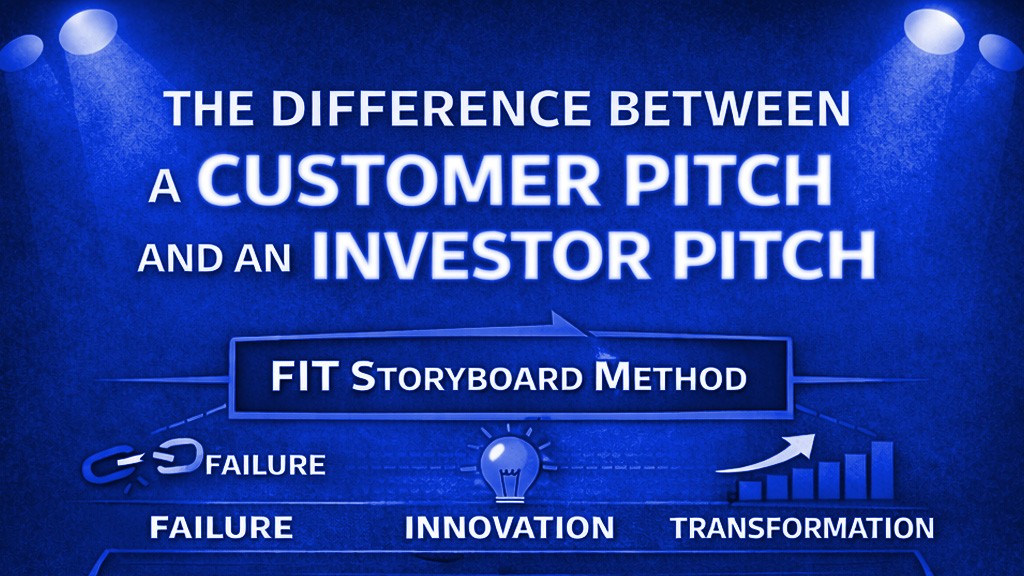
The Difference Between a Customer Pitch and an Investor Pitch

The Difference Between a Customer Pitch and an Investor Pitch


The Difference Between a Customer Pitch and an Investor Pitch

Alejandra Copeland, Founder of Ok Yes Pitch Storytelling

Alejandra Copeland

Alejandra Copeland

Founder of Ok Yes Pitch Storytelling

Founder of Ok Yes Pitch Storytelling

February 7, 2026

February 7, 2026

A customer pitch is designed to generate sales by persuading someone that your product or service solves their problem. An investor pitch, on the other hand, is about convincing someone that your company is a worthwhile financial bet, with strong growth potential and a credible return on investment.

Both require a clear narrative, but they differ dramatically in focus, stakes, and success criteria.

The Primary Goal of Each Type of Pitch

Customer Pitch: Drive Sales

The main objective of a customer pitch is to generate sales or build long-term commercial relationships. It focuses on benefits, outcomes, and relevance, showing how your product or service improves the customer’s life or business.

The real question you must answer is:
Why should they care right now?

In FIT Storytelling terms:

  • Failure: What pain or inefficiency are they dealing with today?

  • Innovation: How does your solution fix it better or faster?

  • Transformation: How do their lives change after seeing positive results?

Investor Pitch: Secure Capital

An investor pitch exists to raise funding. It focuses on the business model, scalability, market opportunity, profitability, and leadership team.

Investors aren’t buying your product.
They’re buying your trajectory.

In FIT Storytelling terms:

  • Failure: What market inefficiency or gap exists?

  • Innovation: Why is your approach defensible and scalable?

  • Transformation: What does success look like at scale—and how big can it get?
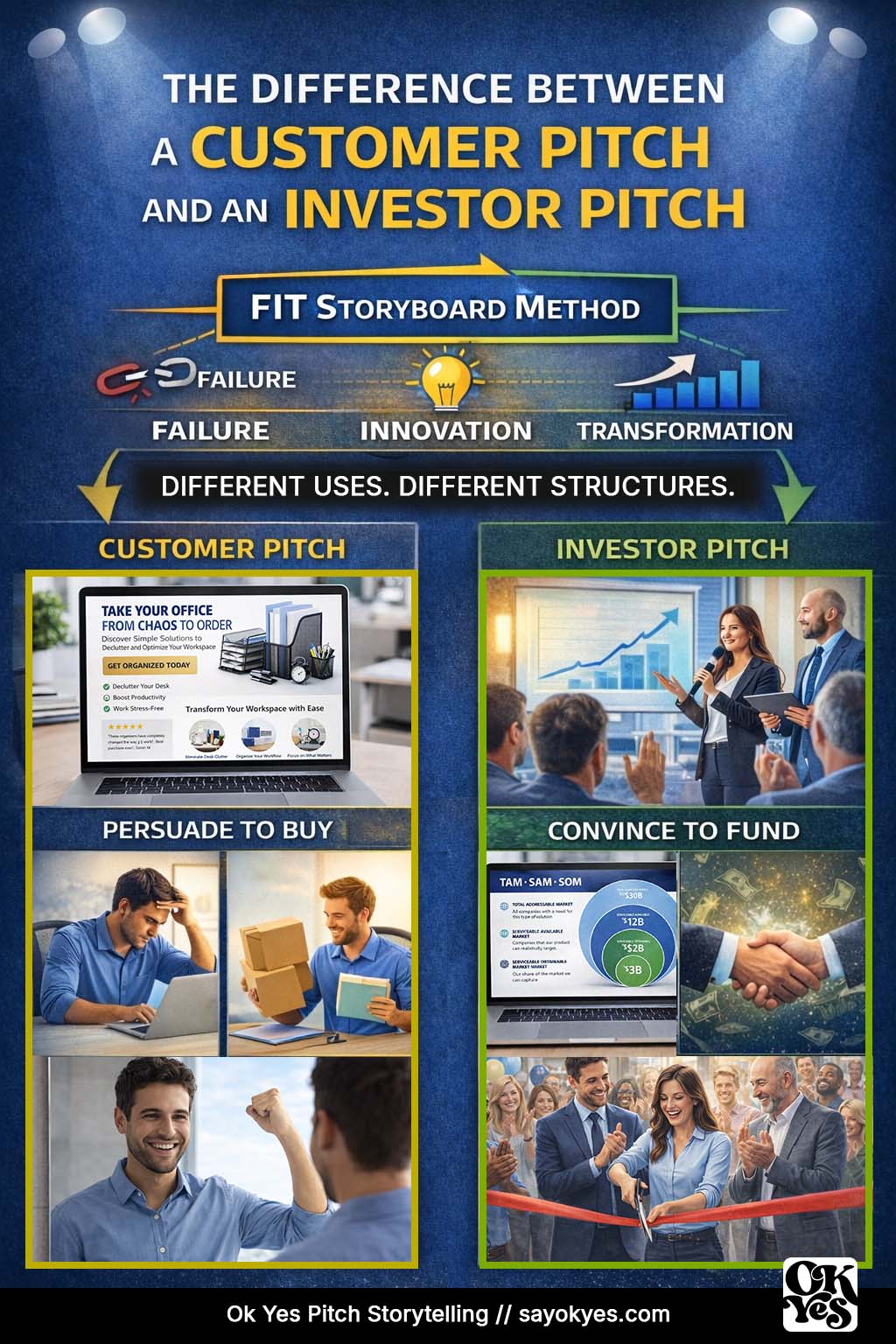
The difference between a customer pitch and an investor pitch

What is the most important part of any pitch?

A clear problem-solution

Regardless of what type of pitch you are building, the most important part of the pitch will be to communicate what problem you solve and how (incredibly) well you do it.

Remember, people don’t buy solutions in isolation. They buy relief, progress, and momentum.

A clear Problem–Solution story:

• Helps your audience see themselves in the situation

• Makes the pain tangible and specific

• Frames your offer as necessary

When someone recognizes their own struggle in your story, understanding your value becomes effortless. The Ok Yes FIT Storyboard is a proven tool to plot your problem-solution.

What to Include in a Customer Pitch

A strong customer pitch should include:

  • Problem Identification
    Clearly define the problem your customer recognizes as urgent.

  • Proposed Solution
    Explain how your product or service solves that problem—without overexplaining.

  • Key Benefits
    Focus on tangible outcomes, not features.

  • Social Proof or Use Cases
    Show how others have already succeeded with your solution.

  • Clear Call to Action
    Tell them exactly what to do next: book a demo, request a quote, start a trial.

Customer pitches live or die on clarity and relevance.

What to Include in an Investor Pitch

A solid investor pitch should cover:

  • The Problem-Solution
    How your offer solves your customer's problem.

  • Market Opportunity
    Size, demand, and timing of the market you’re targeting.

  • Business Model
    How you make money—and how that scales.

  • Competitive Advantage
    What makes you hard to replace or copy.

  • Financial Projections
    Realistic forecasts for revenue, costs, and profitability.

  • Leadership Team
    Why this team can actually execute.

  • The Ask
    How much capital you’re raising and exactly how it will be used.

Investor pitches are about confidence, credibility, and upside.

Adapting Tone and Language for Each Audience

For Customers

  • Persuasive, human, benefit-driven

  • Minimal jargon

  • Focused on outcomes and ease

Speak in their language, not yours.

For Investors

  • Professional, data-backed, strategic

  • Comfortable with financial and market terminology

  • Focused on growth, risk, and returns

Here, precision beats passion.

The Best Format for Each Pitch

  • Customer pitches are flexible: live conversations, demos, videos, sales decks, even calls. What matters is adapting to the customer’s context.

  • Investor pitches are usually formal slide presentations. Visual clarity and logical flow matter, and you must be ready for tough questions.

Different rooms. Different expectations.

How to Measure Success

  • Customer pitch success = sales, conversions, follow-ups, long-term relationships.

  • Investor pitch success = funding secured, valuation achieved, strategic investors onboarded.

If nothing moves forward, the pitch didn’t work, no matter how polished it looked.

Common Mistakes to Avoid in Both Types of Pitches

  • Not understanding your audience.

  • Lacking a clear story

  • Overloading with information

  • Being unprepared for questions

  • Failing to follow up

The biggest mistake?
Treating all pitches the same.

Final Thought: One Structure. Two Very Different Outcomes.

After working with founders, operators, and executives across industries, one pattern shows up again and again:
Most pitches fail not because the idea is weak, but because the story is misaligned with the room.

A customer pitch and an investor pitch may share the same core idea, but they serve different decision-makers, different risks, and different motivations. Treating them as interchangeable is one of the fastest ways to stall momentum.

That’s why structure matters.

The FIT Storyboard exists to bring clarity before polish. It helps you frame the real problem, position your innovation, and clearly articulate the transformation on the other side. When that narrative is solid, adapting it for customers or investors becomes strategic instead of stressful.

Good pitches sound confident.
Great pitches move conversations forward.

If your message is clear, your audience will tell you through follow-ups, decisions, and action. And if it’s not, no amount of slides, data, or delivery tricks will fix it.

Clarity isn’t a nice-to-have.
It’s the difference between being heard and being remembered.

Next Steps to Strengthen Your Pitch

If your pitch sounds good but doesn’t convert, the issue isn’t delivery: it’s structure.

At Ok Yes Pitch Storytelling, we help founders and leaders adapt their story to the room they’re in, using the FIT Storyboard Method to make every pitch intentional, focused, and outcome-driven.

If you’re ready to stop pitching and start moving conversations forward, that’s where we come in. Email us today.

A customer pitch is designed to generate sales by persuading someone that your product or service solves their problem. An investor pitch, on the other hand, is about convincing someone that your company is a worthwhile financial bet, with strong growth potential and a credible return on investment.

Both require a clear narrative, but they differ dramatically in focus, stakes, and success criteria.

The Primary Goal of Each Type of Pitch

Customer Pitch: Drive Sales

The main objective of a customer pitch is to generate sales or build long-term commercial relationships. It focuses on benefits, outcomes, and relevance, showing how your product or service improves the customer’s life or business.

The real question you must answer is:
Why should they care right now?

In FIT Storytelling terms:

  • Failure: What pain or inefficiency are they dealing with today?

  • Innovation: How does your solution fix it better or faster?

  • Transformation: How do their lives change after seeing positive results?

Investor Pitch: Secure Capital

An investor pitch exists to raise funding. It focuses on the business model, scalability, market opportunity, profitability, and leadership team.

Investors aren’t buying your product.
They’re buying your trajectory.

In FIT Storytelling terms:

  • Failure: What market inefficiency or gap exists?

  • Innovation: Why is your approach defensible and scalable?

  • Transformation: What does success look like at scale—and how big can it get?

The difference between a customer pitch and an investor pitch

What is the most important part of any pitch?

A clear problem-solution

Regardless of what type of pitch you are building, the most important part of the pitch will be to communicate what problem you solve and how (incredibly) well you do it.

Remember, people don’t buy solutions in isolation. They buy relief, progress, and momentum.

A clear Problem–Solution story:

• Helps your audience see themselves in the situation

• Makes the pain tangible and specific

• Frames your offer as necessary

When someone recognizes their own struggle in your story, understanding your value becomes effortless. The Ok Yes FIT Storyboard is a proven tool to plot your problem-solution.

What to Include in a Customer Pitch

A strong customer pitch should include:

  • Problem Identification
    Clearly define the problem your customer recognizes as urgent.

  • Proposed Solution
    Explain how your product or service solves that problem—without overexplaining.

  • Key Benefits
    Focus on tangible outcomes, not features.

  • Social Proof or Use Cases
    Show how others have already succeeded with your solution.

  • Clear Call to Action
    Tell them exactly what to do next: book a demo, request a quote, start a trial.

Customer pitches live or die on clarity and relevance.

What to Include in an Investor Pitch

A solid investor pitch should cover:

  • The Problem-Solution
    How your offer solves your customer's problem.

  • Market Opportunity
    Size, demand, and timing of the market you’re targeting.

  • Business Model
    How you make money—and how that scales.

  • Competitive Advantage
    What makes you hard to replace or copy.

  • Financial Projections
    Realistic forecasts for revenue, costs, and profitability.

  • Leadership Team
    Why this team can actually execute.

  • The Ask
    How much capital you’re raising and exactly how it will be used.

Investor pitches are about confidence, credibility, and upside.

Adapting Tone and Language for Each Audience

For Customers

  • Persuasive, human, benefit-driven

  • Minimal jargon

  • Focused on outcomes and ease

Speak in their language, not yours.

For Investors

  • Professional, data-backed, strategic

  • Comfortable with financial and market terminology

  • Focused on growth, risk, and returns

Here, precision beats passion.

The Best Format for Each Pitch

  • Customer pitches are flexible: live conversations, demos, videos, sales decks, even calls. What matters is adapting to the customer’s context.

  • Investor pitches are usually formal slide presentations. Visual clarity and logical flow matter, and you must be ready for tough questions.

Different rooms. Different expectations.

How to Measure Success

  • Customer pitch success = sales, conversions, follow-ups, long-term relationships.

  • Investor pitch success = funding secured, valuation achieved, strategic investors onboarded.

If nothing moves forward, the pitch didn’t work, no matter how polished it looked.

Common Mistakes to Avoid in Both Types of Pitches

  • Not understanding your audience.

  • Lacking a clear story

  • Overloading with information

  • Being unprepared for questions

  • Failing to follow up

The biggest mistake?
Treating all pitches the same.

Final Thought: One Structure. Two Very Different Outcomes.

After working with founders, operators, and executives across industries, one pattern shows up again and again:
Most pitches fail not because the idea is weak, but because the story is misaligned with the room.

A customer pitch and an investor pitch may share the same core idea, but they serve different decision-makers, different risks, and different motivations. Treating them as interchangeable is one of the fastest ways to stall momentum.

That’s why structure matters.

The FIT Storyboard exists to bring clarity before polish. It helps you frame the real problem, position your innovation, and clearly articulate the transformation on the other side. When that narrative is solid, adapting it for customers or investors becomes strategic instead of stressful.

Good pitches sound confident.
Great pitches move conversations forward.

If your message is clear, your audience will tell you through follow-ups, decisions, and action. And if it’s not, no amount of slides, data, or delivery tricks will fix it.

Clarity isn’t a nice-to-have.
It’s the difference between being heard and being remembered.

Next Steps to Strengthen Your Pitch

If your pitch sounds good but doesn’t convert, the issue isn’t delivery: it’s structure.

At Ok Yes Pitch Storytelling, we help founders and leaders adapt their story to the room they’re in, using the FIT Storyboard Method to make every pitch intentional, focused, and outcome-driven.

If you’re ready to stop pitching and start moving conversations forward, that’s where we come in. Email us today.

A customer pitch is designed to generate sales by persuading someone that your product or service solves their problem. An investor pitch, on the other hand, is about convincing someone that your company is a worthwhile financial bet, with strong growth potential and a credible return on investment.

Both require a clear narrative, but they differ dramatically in focus, stakes, and success criteria.

The Primary Goal of Each Type of Pitch

Customer Pitch: Drive Sales

The main objective of a customer pitch is to generate sales or build long-term commercial relationships. It focuses on benefits, outcomes, and relevance, showing how your product or service improves the customer’s life or business.

The real question you must answer is:
Why should they care right now?

In FIT Storytelling terms:

  • Failure: What pain or inefficiency are they dealing with today?

  • Innovation: How does your solution fix it better or faster?

  • Transformation: How do their lives change after seeing positive results?

Investor Pitch: Secure Capital

An investor pitch exists to raise funding. It focuses on the business model, scalability, market opportunity, profitability, and leadership team.

Investors aren’t buying your product.
They’re buying your trajectory.

In FIT Storytelling terms:

  • Failure: What market inefficiency or gap exists?

  • Innovation: Why is your approach defensible and scalable?

  • Transformation: What does success look like at scale—and how big can it get?

The difference between a customer pitch and an investor pitch

What is the most important part of any pitch?

A clear problem-solution

Regardless of what type of pitch you are building, the most important part of the pitch will be to communicate what problem you solve and how (incredibly) well you do it.

Remember, people don’t buy solutions in isolation. They buy relief, progress, and momentum.

A clear Problem–Solution story:

• Helps your audience see themselves in the situation

• Makes the pain tangible and specific

• Frames your offer as necessary

When someone recognizes their own struggle in your story, understanding your value becomes effortless. The Ok Yes FIT Storyboard is a proven tool to plot your problem-solution.

What to Include in a Customer Pitch

A strong customer pitch should include:

  • Problem Identification
    Clearly define the problem your customer recognizes as urgent.

  • Proposed Solution
    Explain how your product or service solves that problem—without overexplaining.

  • Key Benefits
    Focus on tangible outcomes, not features.

  • Social Proof or Use Cases
    Show how others have already succeeded with your solution.

  • Clear Call to Action
    Tell them exactly what to do next: book a demo, request a quote, start a trial.

Customer pitches live or die on clarity and relevance.

What to Include in an Investor Pitch

A solid investor pitch should cover:

  • The Problem-Solution
    How your offer solves your customer's problem.

  • Market Opportunity
    Size, demand, and timing of the market you’re targeting.

  • Business Model
    How you make money—and how that scales.

  • Competitive Advantage
    What makes you hard to replace or copy.

  • Financial Projections
    Realistic forecasts for revenue, costs, and profitability.

  • Leadership Team
    Why this team can actually execute.

  • The Ask
    How much capital you’re raising and exactly how it will be used.

Investor pitches are about confidence, credibility, and upside.

Adapting Tone and Language for Each Audience

For Customers

  • Persuasive, human, benefit-driven

  • Minimal jargon

  • Focused on outcomes and ease

Speak in their language, not yours.

For Investors

  • Professional, data-backed, strategic

  • Comfortable with financial and market terminology

  • Focused on growth, risk, and returns

Here, precision beats passion.

The Best Format for Each Pitch

  • Customer pitches are flexible: live conversations, demos, videos, sales decks, even calls. What matters is adapting to the customer’s context.

  • Investor pitches are usually formal slide presentations. Visual clarity and logical flow matter, and you must be ready for tough questions.

Different rooms. Different expectations.

How to Measure Success

  • Customer pitch success = sales, conversions, follow-ups, long-term relationships.

  • Investor pitch success = funding secured, valuation achieved, strategic investors onboarded.

If nothing moves forward, the pitch didn’t work, no matter how polished it looked.

Common Mistakes to Avoid in Both Types of Pitches

  • Not understanding your audience.

  • Lacking a clear story

  • Overloading with information

  • Being unprepared for questions

  • Failing to follow up

The biggest mistake?
Treating all pitches the same.

Final Thought: One Structure. Two Very Different Outcomes.

After working with founders, operators, and executives across industries, one pattern shows up again and again:
Most pitches fail not because the idea is weak, but because the story is misaligned with the room.

A customer pitch and an investor pitch may share the same core idea, but they serve different decision-makers, different risks, and different motivations. Treating them as interchangeable is one of the fastest ways to stall momentum.

That’s why structure matters.

The FIT Storyboard exists to bring clarity before polish. It helps you frame the real problem, position your innovation, and clearly articulate the transformation on the other side. When that narrative is solid, adapting it for customers or investors becomes strategic instead of stressful.

Good pitches sound confident.
Great pitches move conversations forward.

If your message is clear, your audience will tell you through follow-ups, decisions, and action. And if it’s not, no amount of slides, data, or delivery tricks will fix it.

Clarity isn’t a nice-to-have.
It’s the difference between being heard and being remembered.

Next Steps to Strengthen Your Pitch

If your pitch sounds good but doesn’t convert, the issue isn’t delivery: it’s structure.

At Ok Yes Pitch Storytelling, we help founders and leaders adapt their story to the room they’re in, using the FIT Storyboard Method to make every pitch intentional, focused, and outcome-driven.

If you’re ready to stop pitching and start moving conversations forward, that’s where we come in. Email us today.

Alejandra Copeland, Founder of Ok Yes Pitch Storytelling

About Ok Yes Founder, Alejandra Copeland

Alejandra Copeland cut her teeth as a visual communication expert by producing and editing video content for MTV Networks, NBC Universal, and Viacom. Since 2004, Alejandra has pushed Andromeda Productions as a premier marketing video production agency. She has created enduring client relationships with multiple Fortune 500 companies such as MasterCard and Sony Music US Latin.

Alejandra Copeland cut her teeth as a visual communication expert by producing and editing video content for MTV Networks, NBC Universal, and Viacom. Since 2004, Alejandra has pushed Andromeda Productions as a premier marketing video production agency. She has created enduring client relationships with multiple Fortune 500 companies such as MasterCard and Sony Music US Latin.

All rights reserved © 2026 OK YES LLC.

All rights reserved © 2026 OK YES LLC.

All rights reserved © 2026 OK YES LLC.