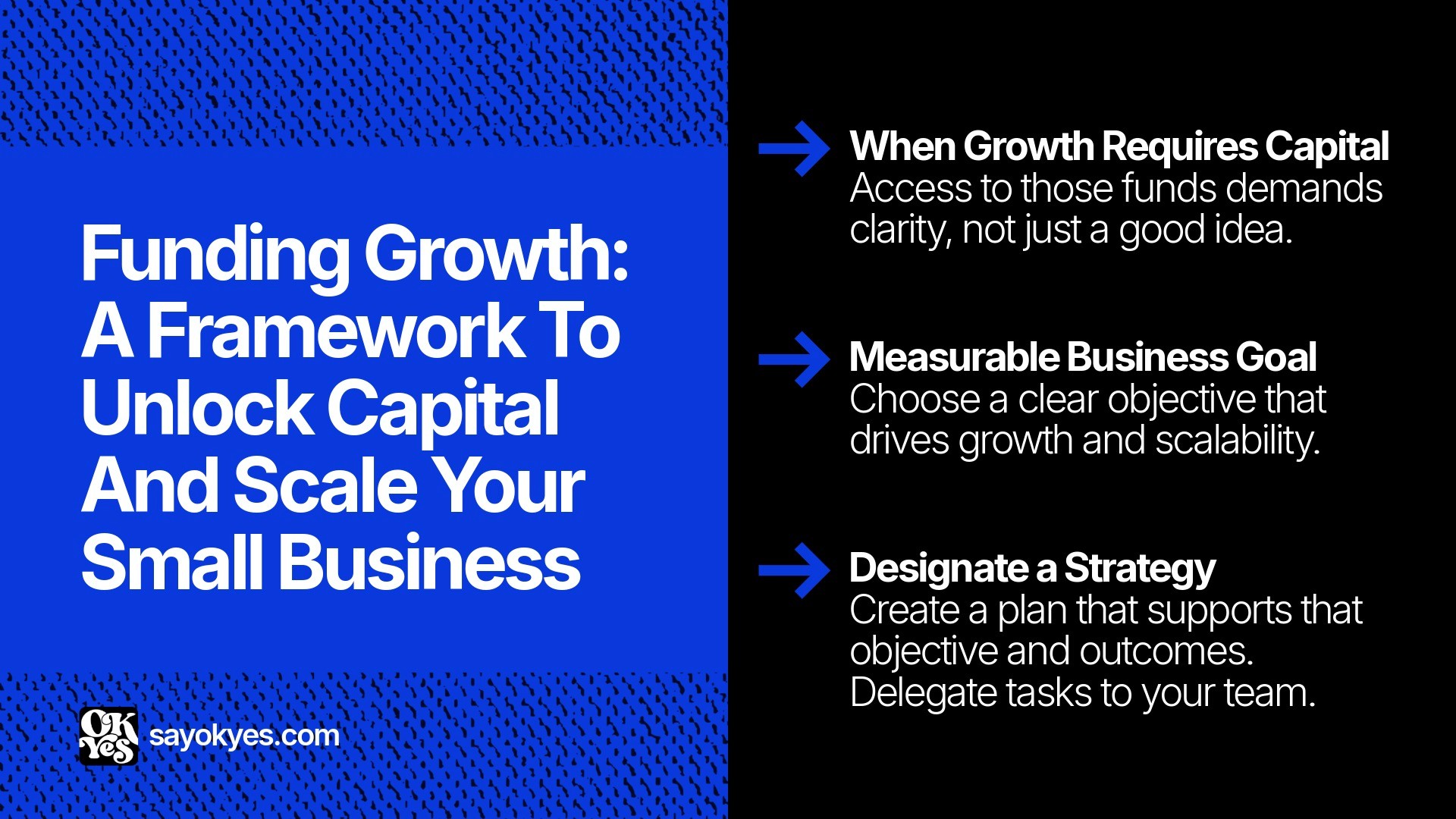
Funding Growth: A Framework To Unlock Capital And Scale Your Small Business

At some point, every small business hits a ceiling.
You’ve proven the concept, you have customers and revenue is coming in.
But there’s a point where growth stalls:
It’s not because the opportunity isn’t there, but because you, as a small business, have run out of capacity to chase it.
That’s the moment no one talks about enough. That proverbial quantum leap.
At a certain stage, growth stops being organic and it becomes a decision:
A decision to hire faster than you’re comfortable with.
To invest before the return is guaranteed.
To scale operations, marketing, or product in a way that your current cash flow simply can’t support.
That’s where capital comes in.
Now, this capital isn't as a safety net but a growth accelerator.
It’s a way to compress time and do in 6 months what would otherwise take 2 years.
How hard is it for a small business to get access to capital?
Even for something as “simple” as a credit line or a small business loan, the level of scrutiny is intense. Lenders are reporting tighter criteria, digging into:
Your revenue consistency
Your margins
Your debt
Your projections
Your ability to repay (not just eventually, but predictably.)
And if anything feels unclear, inconsistent, or overly optimistic… the answer is no.
Not “come back later.” Just NO.
Walking into that process unprepared is risky and potentially a frustrating waste of time.
Because at that level, it’s not about whether your business is “good.”
It’s about whether you can demonstrate, with clarity and confidence, that you know exactly what you’re doing with the money and how it translates into growth.
And yet… this is exactly where most businesses get stuck.
Because the moment they need funding, they default to what they know best:
They try to sell.
A simple small business framework for funding
That’s what I shared during a recent workshop I led for entrepreneurs here in Florida.
My job was to make those small business owners think about growth without approaching it like a sales conversation.
As entrepreneurs, we’re used to pitching our product, our service, our value.
But when we’re asking for capital, to a bank or an investor, they are not there to buy what you sell.
They’re trying to understand what you’re going to do with their money.
Big difference!
So instead of starting with slides or storytelling, I asked them something simple:
If I gave you $10,000 today to grow your business, how would you 10x that investment?
I asked them to think specifically:
Where does it go first?
What happens next?
Who’s responsible?
What result are you expecting?
And that’s where things got interesting.
Because they immediately allocated funds to specific tasks like marketing campaigns, hiring new employees, renting that new location… but didn't have a clear objective or way to measure if that investment will yield growth.
In fact, when asked this question, most people don’t actually have a clear answer.
They have ideas, ambition and a sense of direction but they don’t have a plan that holds up under scrutiny.
And if you can’t clearly explain how you would deploy $10K… Why would anyone trust you with that cash?
That’s the shift we worked through.
You’re not pitching your business. You’re pitching your growth plan.
And that plan needs to be grounded in reality: numbers, timelines, people, execution.
During the workshop, we went from “we want more visibility” to “we want to increase revenue by 30% in 6 months.”
And that’s how the conversation changes into a structured strategy:
Now you can actually map what needs to happen.
Who needs to be involved.
How much it’s going to cost.
So instead of overcomplicating things, I gave them a simple structure to work through.
The framework: A simple plan most small businesses never build
I introduced a deceptively simple but brutally effective 5-part framework:
1. Business Goal
A clear, measurable objective tied directly to growth.
2. Deadline
A real timeline. Not “as soon as possible.”
3. Three Key Activities
The only actions that actually move the needle.
4. Partners & Collaborators
Who is responsible for execution (not just ideas).
5. Budget & Capital
How much money is needed, and where it goes.
Simple? Yes.
Easy? Not at all.
Because it forces you to think like an operator, not just a founder.
The discipline most people avoid when it comes to reaching business goals
Here’s the part that matters more than anything else:
Having the plan is not the hard part.
Sticking to it is.
That’s why I always tell people: don’t just fill it out and move on. Print it. Put it somewhere you can see it every day. Because if it’s out of sight, it’s out of mind, and visibility creates accountability.
That accountability is what turns ideas into outcomes.
At the end of the day, funding doesn’t go to the best idea. It goes to the clearest plan.
And most people lose the opportunity because they’re not clear enough; or they default because they never follow through.
This plan isn’t just about getting access to capital: it’s about kickstarting your growth journey!
The real value isn’t the money itself, it’s the clarity that allows you to use it effectively.
About Ok Yes Pitch Founder, Alejandra Copeland