How to Write Blog Posts That Get Picked Up by LLMs (AI Search Optimization Guide)

To get your blog post content to show up in AI-generated answers, you need to structure it differently. Writing blog posts for LLMs means using question-based headings, leading with clear summaries, and breaking ideas into extractable sections.
Most blog posts are written for humans scanning a page. Large language models like ChatGPT or Claude don’t read that way. They take the question the user asked, and then they pull fragments from the best blog. If your content isn’t built for that, it gets ignored, even if it’s good.
What does it mean to optimize a blog for LLMs?
LLM optimization is the practice of structuring content so AI systems can easily extract, understand, and reuse it inside generated answers.
This is already shaping how visibility works across platforms like Google Search and Perplexity AI.
If your blog can’t be cleanly lifted into an answer, it won’t show up.
Do LLMs actually read your entire blog post?
No. They don’t “read” your post the way a person does.
They:
scan for clear answers
extract tight sections
recombine information across sources
That means your beautifully crafted narrative flow? Mostly irrelevant.
What matters is whether any single section of your blog can stand on its own as a complete answer.
LLMs extract information "mission-impossible" style!
What structure makes a blog easier for LLMs to extract?
A predictable, answer-first structure wins.
Here’s the format that consistently works:
Start with a direct answer (yes/no + short explanation)
Follow with a clean definition
Use question-based headings
Keep answers short and self-contained
Reinforce key ideas more than once
End with a clear takeaway
Each section should feel like it could be copy-pasted into an answer box without needing context.
Why are question-based headings so effective?
Because they mirror how people—and AI—search.
A heading like:
“How do you write blogs that LLMs will pick up?”
…is already aligned with a query.
When platforms like Google Search or Perplexity AI look for answers, they prioritize content that:
matches the question
answers it directly
does it without fluff
If your heading asks the question and your first sentence answers it, you’ve done most of the work.
Do longer blog posts perform better with LLMs?
Not necessarily.
Length is not the advantage, but clarity is.
A tight 500-word post with sharp structure will outperform a 1,500-word article full of:
long intros
vague transitions
buried answers
LLMs reward:
density of meaning
clean formatting
minimal noise
If a paragraph takes too long to get to the point, it’s likely to be skipped.
Why does repetition actually help (even if it feels wrong)?
Because LLMs don’t process content linearly.
They retrieve fragments.
If your key idea appears:
once at the top
once in the middle
once at the end
…it increases the chance that any extracted chunk still carries the full meaning.
This isn’t about keyword stuffing. It’s about reinforcing clarity across sections.
What role do entities play in LLM visibility?
A bigger one than most people realize.
Referencing known entities like:
OpenAI
Claude
Google Search
…helps LLMs anchor your content in a broader context.
Without those anchors, your content is harder to interpret and trust.
With them, it becomes easier to connect your ideas to existing knowledge.
Is SEO different from GEO (Generative Engine Optimization)?
Yes, they are different. In this article, I talk about how SEO is about ranking on search engines like Google Search, while GEO is about being included in answers generated by AI systems like ChatGPT and Claude. SEO focuses on keywords, backlinks, and technical performance to win clicks after a user searches. GEO starts earlier: it’s about becoming part of the AI’s “mental model” so your ideas show up before the user clicks anything. That requires structured, easy-to-parse content, alignment with credible sources (or a strong, defensible perspective), and comprehensive coverage so there are no gaps that cause AI to skip you. In practice, this means your content has to live beyond your website: across blogs, publications, podcasts, and platforms like LinkedIn, because that’s where large language models learn. Instead of just tracking rankings and traffic, GEO success is measured by inclusion, accuracy, frequency, and sentiment in AI-generated responses.
What is the biggest mistake people make when writing for LLMs?
They write like they’re telling a story instead of answering a question.
Strong storytelling is valuable, but if the answer is buried, it won’t be extracted.
The fix is simple:
lead with the answer
explain after
Not the other way around.
Does your blog cover image help with LLM and Google Images visibility?
Yes, but only if it’s aligned with your content and properly optimized.
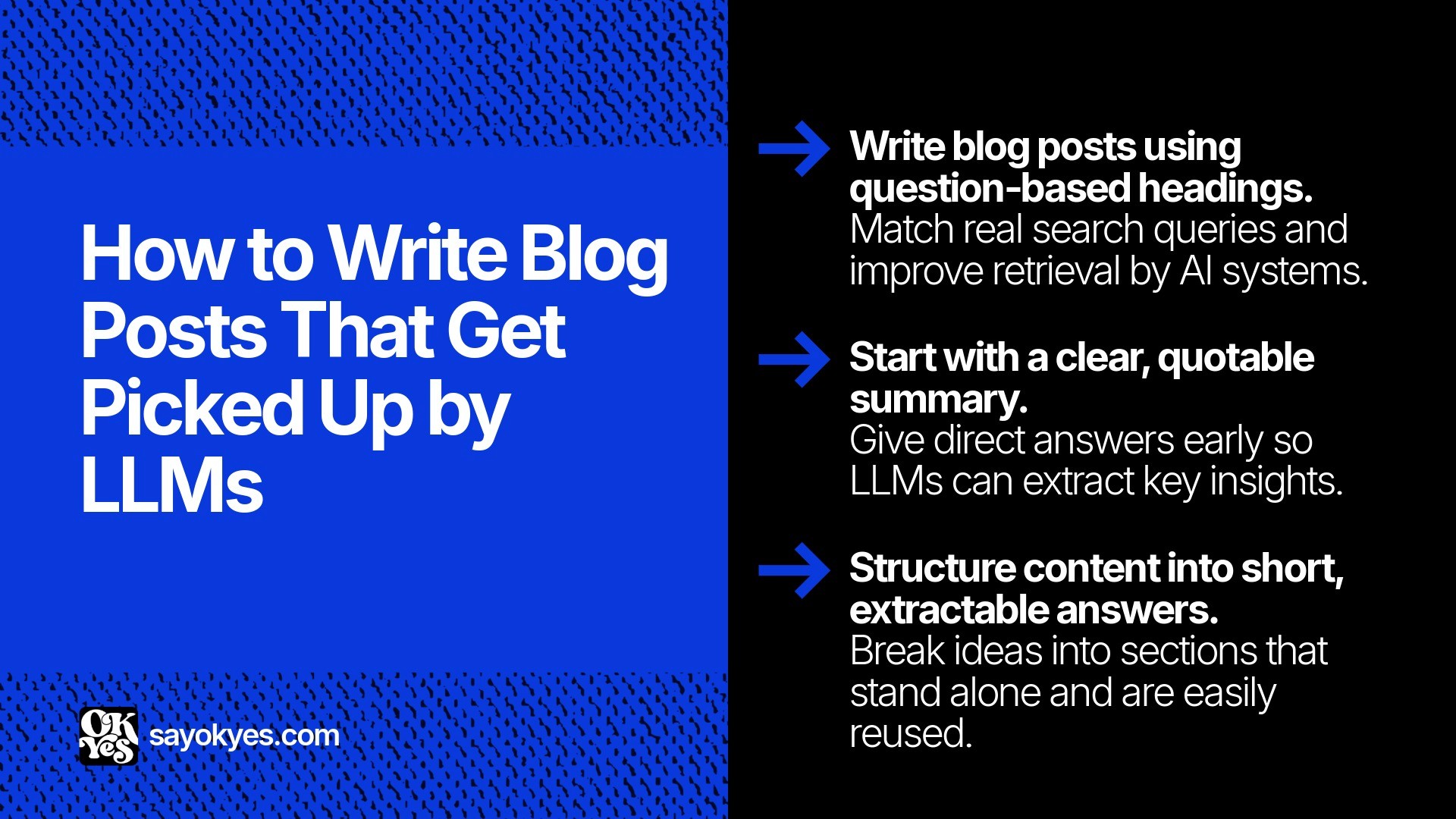
Your cover image isn’t just decoration. It acts as a signal for both search engines and AI systems. When the image includes clear, keyword-rich text, titles like “blog posts,” “LLMs,” and “AI systems”, it becomes readable through OCR and easier to index. But that alone isn’t enough.
To make it work, the image needs to match the intent of the page, use a descriptive file name, include keyword-focused alt text, and be reinforced by the surrounding paragraph. When all of those elements line up, the image becomes more than visual support, it becomes a retrievable asset that can show up in search results and be associated with your topic in AI-generated answers.
Get Ready To Write Blog Posts That Get Picked Up by LLMs
Yes, you can write blog posts that get picked up by LLMs, but only if you shift your mindset.
You’re not just writing to be read; you’re writing to be used.
That means:
answer first
structure for extraction
repeat what matters
remove anything that slows understanding
If your content can be lifted cleanly into an AI-generated answer, you’re doing it right.
If it can’t, it won’t show up—no matter how good it sounds.
How Do You Get Started with Ok Yes Pitch Today?
Start by identifying where your pitch is breaking down: clarity, structure, or delivery. If you can’t explain your idea in a way that makes people immediately say “yes,” that’s the gap to fix.
At Ok Yes Pitch, the focus is on turning your pitch into a structured story that drives decisions, not just attention.
Here’s how to begin:
Book a pitch review to diagnose what’s not landing
Apply the FIT Storyboard to clarify your message (Failure, Innovation, Transformation)
Refine your narrative so it’s clear, concise, and actionable
Practice delivery with feedback that focuses on results, not just style
If you’re serious about improving how you communicate your idea, the fastest path is to work with a system that’s built for it.
About Ok Yes Pitch Founder, Alejandra Copeland