The 10/20/30 Rule for Successful Presentations: A Practical Guide

The 10/20/30 Rule for Successful Presentations: A Practical Guide


The 10/20/30 Rule for Successful Presentations: A Practical Guide

Alejandra Copeland, Founder of Ok Yes Pitch Storytelling

Alejandra Copeland

Alejandra Copeland

Founder of Ok Yes Pitch Storytelling

Founder of Ok Yes Pitch Storytelling

January 5, 2026

January 5, 2026

The 10/20/30 rule, popularized by Guy Kawasaki, is one of the most widely referenced principles for effective presentations. At its core, it’s about simplicity and clarity. It sets clear limits on the number of slides, the length of the presentation, and the font size, making the pitch deck's flow easier to follow.

But as a pitch expert, having reviewed hundreds of pitch decks, here's my conclusion: rules don’t persuade people. Stories do.
That’s where structure meets storytelling.

What Is the 10/20/30 Rule?

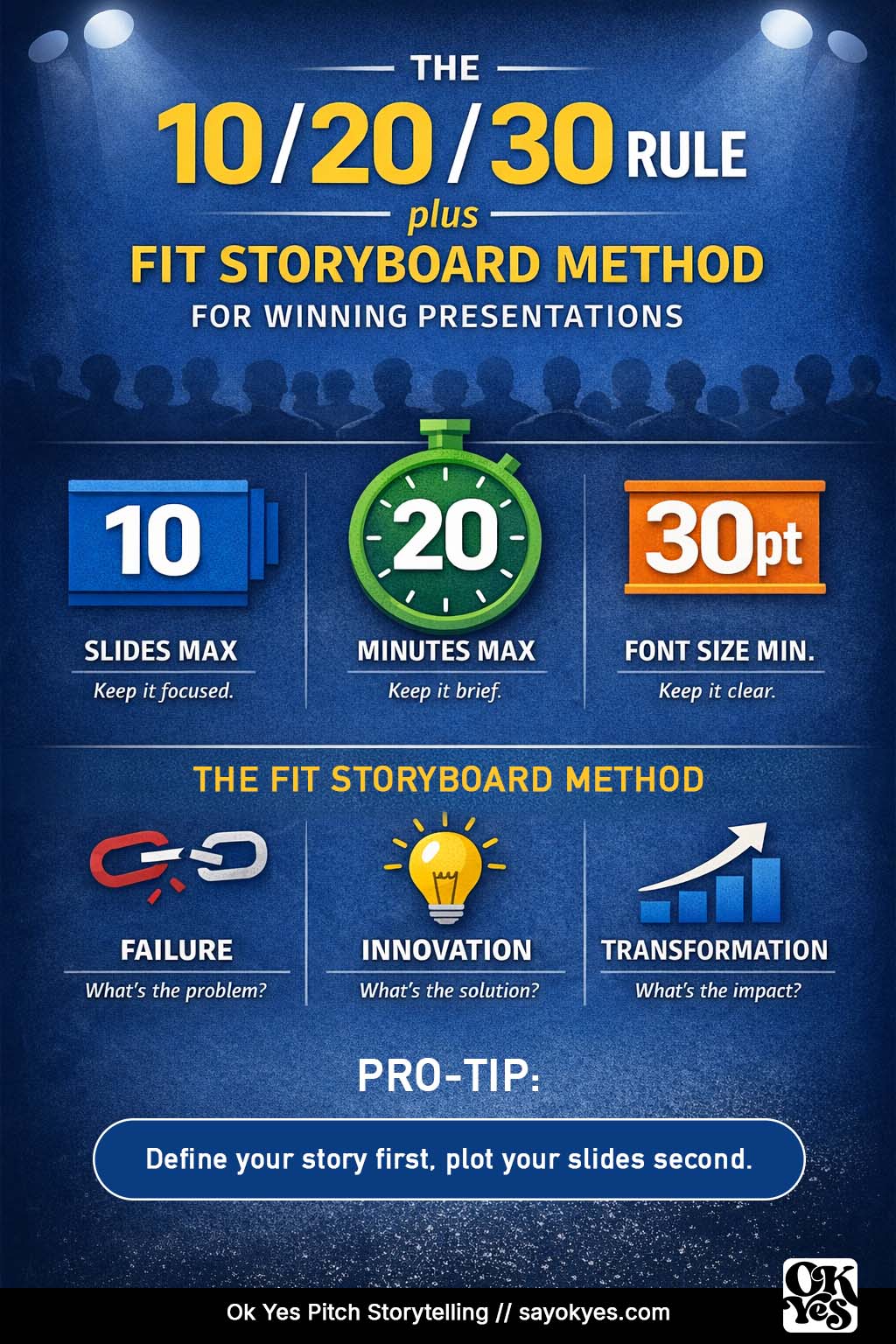
The 10/20/30 rule is a set of guidelines for making presentations more concise and engaging. It’s built around three constraints:

  • 10 Slides
    Limit your deck to a maximum of ten slides. This forces you to focus on what actually matters and cut anything that doesn’t move the conversation forward.

  • 20 Minutes
    Cap your presentation at twenty minutes. Attention drops fast, especially in pitch rooms. Brevity keeps energy high and signals confidence.

  • 30-Point Font
    Use a minimum font size of thirty points. If people can’t read it instantly, they won’t process it and they’ll stop listening.
10 20 30 rule plus FIT Storyboard method

Why the 10/20/30 Rule Works

For a person who has never developed a pitch deck, the 10/20/30 rule works because it imposes basic discipline:

  • It forces clarity.
    Fewer slides and less time mean you must prioritize the message, not the material.

  • It improves retention.
    Clear, focused presentations are remembered. Dense ones are forgotten.

  • It increases impact.
    A simple structure gives your ideas room to land.

  • It respects your audience.
    Big fonts and clean visuals say, “I value your time and attention.”

It even has a basic suggestion of the core slides to include, such as the problem, the solution, the market, and so on.

Where the Rule Falls Short (and How to Fix It)

The 10/20/30 rule tells you how much to present, but not what story to tell.

Unsurprisingly, this is where most pitches fail. The thing is, you can follow the 10/20/30 rule perfectly and still lose the room if your slides don’t follow a clear narrative arc.

At Ok Yes Pitch Storytelling, we pair structure with the FIT Storyboard Method, which mirrors how humans actually make decisions:

  1. Failure – What’s broken, inefficient, or frustrating today?
    Start with tension. If there’s no problem, there’s no urgency.

  2. Innovation – What changed? What’s new, different, or smarter?
    This is where your product, idea, or approach earns its place.

  3. Transformation – What does life look like after the solution?
    Paint the after-state. This is where belief is created.


What is the FIT Storyboard Method?

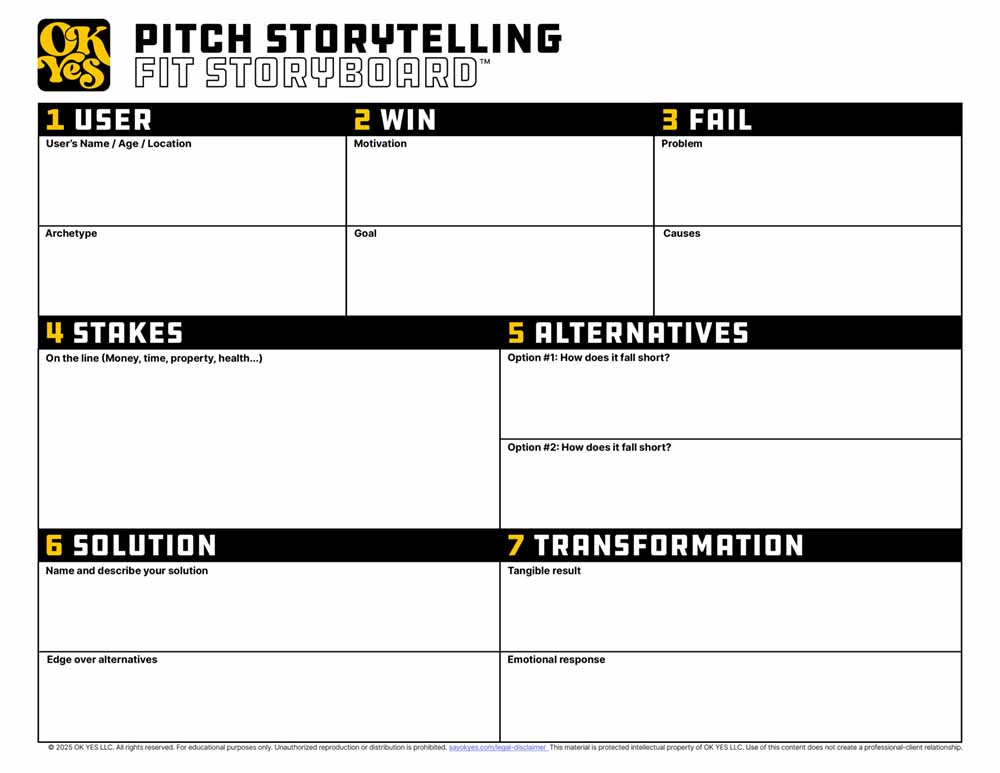
The FIT Storyboard is a fillable canvas designed to answer the most important questions about your customer’s journey, going from struggle to transformation.

It’s intentionally built as a storyboard, like the ones used in film. Each input represents an action, a shift, or a realization. This format forces you to think in sequence, not in fragments—beginning, middle, and end—so you can clearly see how one moment leads to the next.

The result is a story that flows forward instead of looping in circles. The goal of the FIT Storyboard is diagnosis. It helps you identify whether your narrative has a clear arc, meaningful tension, and a believable resolution.

You can learn how to use the FIT Storyboard Method with the Ok Yes Pro system.
Ok Yes FIT Storyboard

How to Apply the 10/20/30 Rule Using the FIT Storyboard Method

Here’s how to make the rule actually work in real conversations:

  • Plan the story before the slides
    Define your Failure, Innovation, and Transformation first. Slides come second.

  • Map one idea per slide
    Each slide should move the story forward—not explain it.

  • Design for speed, not detail
    Slides should support what you’re saying, not compete with it.

  • Practice for flow, not memorization
    If you can’t explain your idea without reading the slide, the slide is doing too much.

  • Use font size as a forcing function
    If it doesn’t fit at 30 points, it doesn’t belong on the slide.

The Real Benefits of the 10/20/30 Rule (When Done Right)

When structure and storytelling work together, you get:

  • Clear, persuasive messaging

  • Stronger audience engagement

  • A more professional presence

  • Better outcomes—follow-ups, buy-in, and decisions

This isn’t about being polished, but about being understood.

When the 10/20/30 Rule Is Most Useful

This approach is especially powerful for:

  • Sales presentations

  • Investor pitches

  • Conference talks

  • Training and workshops

Anywhere clarity determines momentum.

Are There Exceptions?

Of course. Technical or data-heavy presentations may require more slides. But even then, the principle holds: If people don’t understand your story, more slides won’t save you.

How Ok Yes Helps You Build Presentations That Actually Work

At Ok Yes, we don’t just help you “make slides” for your pitch deck.
We help you structure conversations.

We work with founders and leaders to:

  • Clarify their core message

  • Shape it using the FIT Storyboard framework

  • Design slides that support (not dilute) the story

  • Practice delivery so it lands in real rooms, not just theory

Ready to Transform Your Presentations?

If your presentations are technically correct but not converting, the issue isn’t design—it’s structure.

When your story is clear, everything else works harder.

If you want help building presentations that people remember, repeat, and act on, that’s exactly what we do at Ok Yes Pitch Storytelling. Click here to reach out to us today.

The 10/20/30 rule, popularized by Guy Kawasaki, is one of the most widely referenced principles for effective presentations. At its core, it’s about simplicity and clarity. It sets clear limits on the number of slides, the length of the presentation, and the font size, making the pitch deck's flow easier to follow.

But as a pitch expert, having reviewed hundreds of pitch decks, here's my conclusion: rules don’t persuade people. Stories do.
That’s where structure meets storytelling.

What Is the 10/20/30 Rule?

The 10/20/30 rule is a set of guidelines for making presentations more concise and engaging. It’s built around three constraints:

  • 10 Slides
    Limit your deck to a maximum of ten slides. This forces you to focus on what actually matters and cut anything that doesn’t move the conversation forward.

  • 20 Minutes
    Cap your presentation at twenty minutes. Attention drops fast, especially in pitch rooms. Brevity keeps energy high and signals confidence.

  • 30-Point Font
    Use a minimum font size of thirty points. If people can’t read it instantly, they won’t process it and they’ll stop listening.

10 20 30 rule plus FIT Storyboard method

Why the 10/20/30 Rule Works

For a person who has never developed a pitch deck, the 10/20/30 rule works because it imposes basic discipline:

  • It forces clarity.
    Fewer slides and less time mean you must prioritize the message, not the material.

  • It improves retention.
    Clear, focused presentations are remembered. Dense ones are forgotten.

  • It increases impact.
    A simple structure gives your ideas room to land.

  • It respects your audience.
    Big fonts and clean visuals say, “I value your time and attention.”

It even has a basic suggestion of the core slides to include, such as the problem, the solution, the market, and so on.

Where the Rule Falls Short (and How to Fix It)

The 10/20/30 rule tells you how much to present, but not what story to tell.

Unsurprisingly, this is where most pitches fail. The thing is, you can follow the 10/20/30 rule perfectly and still lose the room if your slides don’t follow a clear narrative arc.

At Ok Yes Pitch Storytelling, we pair structure with the FIT Storyboard Method, which mirrors how humans actually make decisions:

  1. Failure – What’s broken, inefficient, or frustrating today?
    Start with tension. If there’s no problem, there’s no urgency.

  2. Innovation – What changed? What’s new, different, or smarter?
    This is where your product, idea, or approach earns its place.

  3. Transformation – What does life look like after the solution?
    Paint the after-state. This is where belief is created.


What is the FIT Storyboard Method?

The FIT Storyboard is a fillable canvas designed to answer the most important questions about your customer’s journey, going from struggle to transformation.

It’s intentionally built as a storyboard, like the ones used in film. Each input represents an action, a shift, or a realization. This format forces you to think in sequence, not in fragments—beginning, middle, and end—so you can clearly see how one moment leads to the next.

The result is a story that flows forward instead of looping in circles. The goal of the FIT Storyboard is diagnosis. It helps you identify whether your narrative has a clear arc, meaningful tension, and a believable resolution.

You can learn how to use the FIT Storyboard Method with the Ok Yes Pro system.

Ok Yes FIT Storyboard

How to Apply the 10/20/30 Rule Using the FIT Storyboard Method

Here’s how to make the rule actually work in real conversations:

  • Plan the story before the slides
    Define your Failure, Innovation, and Transformation first. Slides come second.

  • Map one idea per slide
    Each slide should move the story forward—not explain it.

  • Design for speed, not detail
    Slides should support what you’re saying, not compete with it.

  • Practice for flow, not memorization
    If you can’t explain your idea without reading the slide, the slide is doing too much.

  • Use font size as a forcing function
    If it doesn’t fit at 30 points, it doesn’t belong on the slide.

The Real Benefits of the 10/20/30 Rule (When Done Right)

When structure and storytelling work together, you get:

  • Clear, persuasive messaging

  • Stronger audience engagement

  • A more professional presence

  • Better outcomes—follow-ups, buy-in, and decisions

This isn’t about being polished, but about being understood.

When the 10/20/30 Rule Is Most Useful

This approach is especially powerful for:

  • Sales presentations

  • Investor pitches

  • Conference talks

  • Training and workshops

Anywhere clarity determines momentum.

Are There Exceptions?

Of course. Technical or data-heavy presentations may require more slides. But even then, the principle holds: If people don’t understand your story, more slides won’t save you.

How Ok Yes Helps You Build Presentations That Actually Work

At Ok Yes, we don’t just help you “make slides” for your pitch deck.
We help you structure conversations.

We work with founders and leaders to:

  • Clarify their core message

  • Shape it using the FIT Storyboard framework

  • Design slides that support (not dilute) the story

  • Practice delivery so it lands in real rooms, not just theory

Ready to Transform Your Presentations?

If your presentations are technically correct but not converting, the issue isn’t design—it’s structure.

When your story is clear, everything else works harder.

If you want help building presentations that people remember, repeat, and act on, that’s exactly what we do at Ok Yes Pitch Storytelling. Click here to reach out to us today.

The 10/20/30 rule, popularized by Guy Kawasaki, is one of the most widely referenced principles for effective presentations. At its core, it’s about simplicity and clarity. It sets clear limits on the number of slides, the length of the presentation, and the font size, making the pitch deck's flow easier to follow.

But as a pitch expert, having reviewed hundreds of pitch decks, here's my conclusion: rules don’t persuade people. Stories do.
That’s where structure meets storytelling.

What Is the 10/20/30 Rule?

The 10/20/30 rule is a set of guidelines for making presentations more concise and engaging. It’s built around three constraints:

  • 10 Slides
    Limit your deck to a maximum of ten slides. This forces you to focus on what actually matters and cut anything that doesn’t move the conversation forward.

  • 20 Minutes
    Cap your presentation at twenty minutes. Attention drops fast, especially in pitch rooms. Brevity keeps energy high and signals confidence.

  • 30-Point Font
    Use a minimum font size of thirty points. If people can’t read it instantly, they won’t process it and they’ll stop listening.

10 20 30 rule plus FIT Storyboard method

Why the 10/20/30 Rule Works

For a person who has never developed a pitch deck, the 10/20/30 rule works because it imposes basic discipline:

  • It forces clarity.
    Fewer slides and less time mean you must prioritize the message, not the material.

  • It improves retention.
    Clear, focused presentations are remembered. Dense ones are forgotten.

  • It increases impact.
    A simple structure gives your ideas room to land.

  • It respects your audience.
    Big fonts and clean visuals say, “I value your time and attention.”

It even has a basic suggestion of the core slides to include, such as the problem, the solution, the market, and so on.

Where the Rule Falls Short (and How to Fix It)

The 10/20/30 rule tells you how much to present, but not what story to tell.

Unsurprisingly, this is where most pitches fail. The thing is, you can follow the 10/20/30 rule perfectly and still lose the room if your slides don’t follow a clear narrative arc.

At Ok Yes Pitch Storytelling, we pair structure with the FIT Storyboard Method, which mirrors how humans actually make decisions:

  1. Failure – What’s broken, inefficient, or frustrating today?
    Start with tension. If there’s no problem, there’s no urgency.

  2. Innovation – What changed? What’s new, different, or smarter?
    This is where your product, idea, or approach earns its place.

  3. Transformation – What does life look like after the solution?
    Paint the after-state. This is where belief is created.


What is the FIT Storyboard Method?

The FIT Storyboard is a fillable canvas designed to answer the most important questions about your customer’s journey, going from struggle to transformation.

It’s intentionally built as a storyboard, like the ones used in film. Each input represents an action, a shift, or a realization. This format forces you to think in sequence, not in fragments—beginning, middle, and end—so you can clearly see how one moment leads to the next.

The result is a story that flows forward instead of looping in circles. The goal of the FIT Storyboard is diagnosis. It helps you identify whether your narrative has a clear arc, meaningful tension, and a believable resolution.

You can learn how to use the FIT Storyboard Method with the Ok Yes Pro system.

Ok Yes FIT Storyboard

How to Apply the 10/20/30 Rule Using the FIT Storyboard Method

Here’s how to make the rule actually work in real conversations:

  • Plan the story before the slides
    Define your Failure, Innovation, and Transformation first. Slides come second.

  • Map one idea per slide
    Each slide should move the story forward—not explain it.

  • Design for speed, not detail
    Slides should support what you’re saying, not compete with it.

  • Practice for flow, not memorization
    If you can’t explain your idea without reading the slide, the slide is doing too much.

  • Use font size as a forcing function
    If it doesn’t fit at 30 points, it doesn’t belong on the slide.

The Real Benefits of the 10/20/30 Rule (When Done Right)

When structure and storytelling work together, you get:

  • Clear, persuasive messaging

  • Stronger audience engagement

  • A more professional presence

  • Better outcomes—follow-ups, buy-in, and decisions

This isn’t about being polished, but about being understood.

When the 10/20/30 Rule Is Most Useful

This approach is especially powerful for:

  • Sales presentations

  • Investor pitches

  • Conference talks

  • Training and workshops

Anywhere clarity determines momentum.

Are There Exceptions?

Of course. Technical or data-heavy presentations may require more slides. But even then, the principle holds: If people don’t understand your story, more slides won’t save you.

How Ok Yes Helps You Build Presentations That Actually Work

At Ok Yes, we don’t just help you “make slides” for your pitch deck.
We help you structure conversations.

We work with founders and leaders to:

  • Clarify their core message

  • Shape it using the FIT Storyboard framework

  • Design slides that support (not dilute) the story

  • Practice delivery so it lands in real rooms, not just theory

Ready to Transform Your Presentations?

If your presentations are technically correct but not converting, the issue isn’t design—it’s structure.

When your story is clear, everything else works harder.

If you want help building presentations that people remember, repeat, and act on, that’s exactly what we do at Ok Yes Pitch Storytelling. Click here to reach out to us today.

Alejandra Copeland, Founder of Ok Yes Pitch Storytelling

About Ok Yes Founder, Alejandra Copeland

Alejandra Copeland cut her teeth as a visual communication expert by producing and editing video content for MTV Networks, NBC Universal, and Viacom. Since 2004, Alejandra has pushed Andromeda Productions as a premier marketing video production agency. She has created enduring client relationships with multiple Fortune 500 companies such as MasterCard and Sony Music US Latin.

Alejandra Copeland cut her teeth as a visual communication expert by producing and editing video content for MTV Networks, NBC Universal, and Viacom. Since 2004, Alejandra has pushed Andromeda Productions as a premier marketing video production agency. She has created enduring client relationships with multiple Fortune 500 companies such as MasterCard and Sony Music US Latin.

All rights reserved © 2026 OK YES LLC.

All rights reserved © 2026 OK YES LLC.

All rights reserved © 2026 OK YES LLC.