What’s the Difference Between a Pitch and a Speech?

What’s the Difference Between a Pitch and a Speech?


What’s the Difference Between a Pitch and a Speech?

Alejandra Copeland, Founder of Ok Yes Pitch Storytelling

Alejandra Copeland

Alejandra Copeland

Founder of Ok Yes Pitch Storytelling

Founder of Ok Yes Pitch Storytelling

January 22, 2026

January 22, 2026

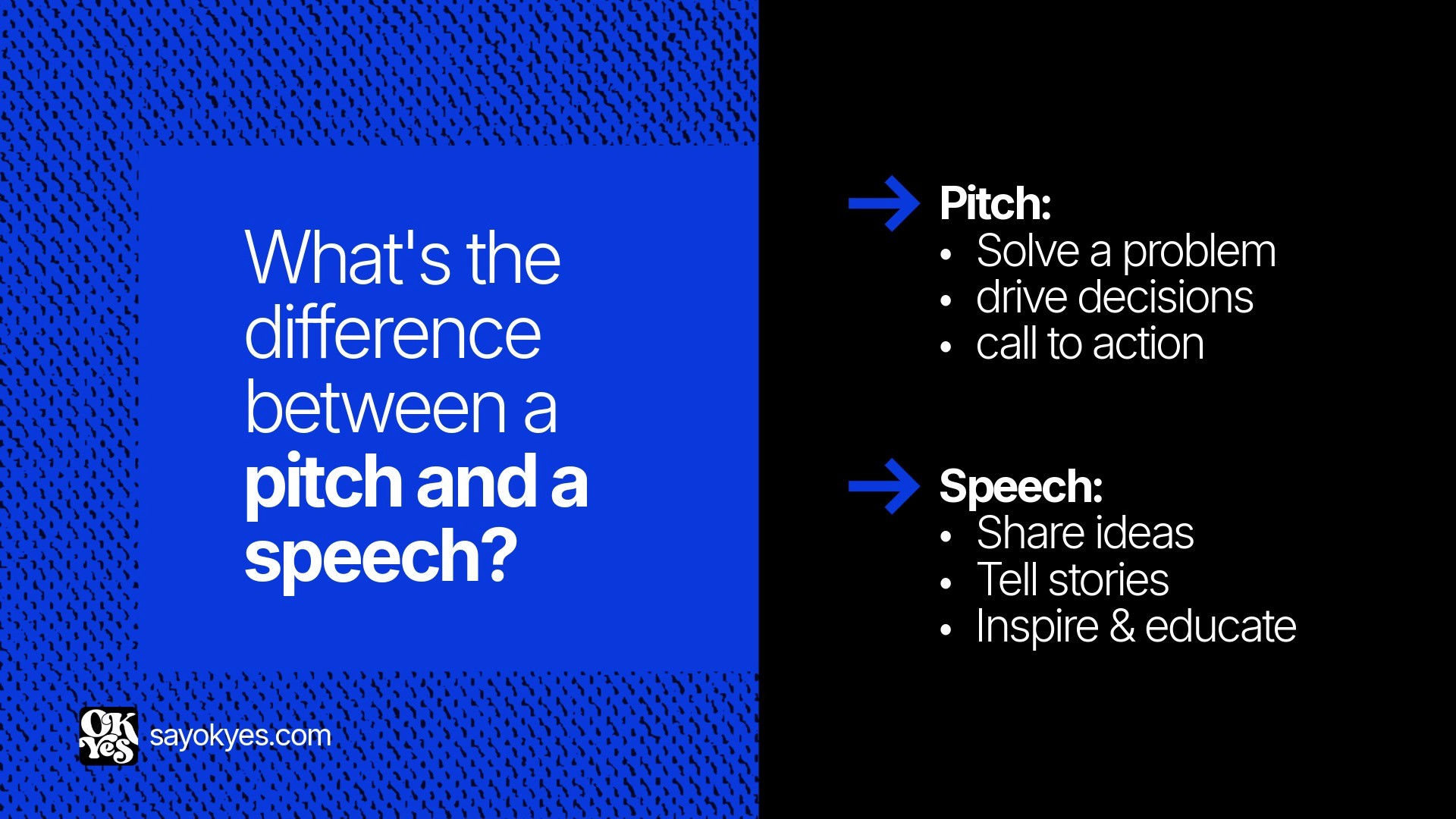
A pitch and a speech are both forms of communication, but they serve different purposes and focus on different things. A pitch is designed to persuade an audience to take action (invest, buy, collaborate), while a speech may aim to inform, entertain, or inspire. Ok Yes Pitch Storytelling helps you master both by adapting your message for maximum impact.

Why do people confuse 'pitch' with 'speech'

In my years working with founders, executives, and creative teams, I’ve repeatedly seen how people blur the line between a pitch and a speech.

Part of it is linguistic because the words sound similar. However, most of the confusion comes from practice. Many people prepare a pitch presentation as if it were a speech: well-written, thoughtful, even inspiring… yet directionless. I’ve been there myself. Early in my career, I delivered talks that landed well but didn’t move the talk forward. That’s when I realized the difference is in style with intent.

A pitch must drive a decision, while a speech earns attention and trust. Once you understand that distinction, everything about how you structure and deliver your message changes.

What Is a Pitch? Definition and Key Characteristics

A pitch is a concise, persuasive presentation designed to elicit a specific response from an audience. In the Ok Yes Pitch Storytelling framework, an effective pitch focuses on:

  • Clarity: The message must be easy to understand and remember.

  • Relevance: It must address the audience’s needs and interests.

  • Credibility: It should be supported by data and evidence.

  • Emotion: It must connect with the audience on an emotional level.

  • Action: It must move the audience to take a specific action.

A successful Ok Yes Pitch Storytelling pitch follows a clear structure that includes:

  1. Problem identification: Presenting a problem the audience recognizes.

  2. Solution presentation: Offering a product, service, or idea that solves the problem.

  3. Value demonstration: Showing how the solution benefits the audience.

  4. Call to action: Requesting a specific action (investment, purchase, collaboration).

What Is a Speech? Definition and Key Characteristics

A speech is an oral presentation designed to communicate a message to an audience. Unlike a pitch, the primary goal of a speech is not always persuasion, but rather to inform, entertain, inspire, or motivate. Ok Yes Pitch Storytelling adapts storytelling techniques to create memorable and effective speeches.

Key characteristics of an effective speech include:

  • Clear purpose: The speaker must have a clear objective in mind.

  • Logical structure: The speech should have a clear introduction, body, and conclusion.

  • Appropriate language: The language should suit the audience and the context.

  • Effective delivery: The speaker should communicate with clarity, confidence, and enthusiasm.

  • Audience connection: The speaker should connect through eye contact, body language, and tone of voice.

Fundamental Differences Between a Pitch and a Speech

The central difference lies in the objective: a pitch seeks a specific action, while a speech serves a broader purpose. Here are the key differences:


Objective

Persuade toward a specific action

Inform, entertain, inspire, motivate

Length

Generally short and concise

Can vary in length

Focus

Problem-solving, value proposition

Message delivery

Audience

Investors, prospects, partners

General public, employees, colleagues

Structure

Problem, solution, value, call to action

Introduction, body, conclusion

Tone

Persuasive, energetic, direct

Variable, depending on purpose

When to Use a Pitch vs. a Speech: Practical Examples

  • Pitch: Ideal for investor meetings, sales presentations, startup competitions. For example, presenting your idea to a group of investors at an Ok Yes Pitch Storytelling event.

  • Speech: Suitable for conferences, graduation ceremonies, internal company presentations. For example, delivering a motivational talk to Ok Yes Pitch Storytelling employees about the importance of effective communication.

How Ok Yes Pitch Storytelling Integrates Both Concepts

Ok Yes Pitch Storytelling integrates both concepts by teaching clients how to tell persuasive and effective stories, regardless of format. The focus is on:

  • Adaptability: Learning how to adapt the message to the audience and objective.

  • Structure: Mastering narrative structures for both pitches and speeches.

  • Delivery: Developing communication skills that capture and hold attention.

  • Confidence: Building presentation confidence through practice and feedback.

Success Stories with Ok Yes Pitch Storytelling

Clients of Ok Yes Pitch Storytelling have succeeded in:

  • Securing funding for their startups.

  • Closing major business deals.

  • Improving their public image.

  • Inspiring their teams.

These results demonstrate the power of clear, well-structured communication—whether in a pitch or a speech.

Next Steps to Improve Your Communication Skills

Ready to transform the way you communicate? Contact Ok Yes Pitch Storytelling today and discover how we can help you master the art of both the pitch and the speech.

A pitch and a speech are both forms of communication, but they serve different purposes and focus on different things. A pitch is designed to persuade an audience to take action (invest, buy, collaborate), while a speech may aim to inform, entertain, or inspire. Ok Yes Pitch Storytelling helps you master both by adapting your message for maximum impact.

Why do people confuse 'pitch' with 'speech'

In my years working with founders, executives, and creative teams, I’ve repeatedly seen how people blur the line between a pitch and a speech.

Part of it is linguistic because the words sound similar. However, most of the confusion comes from practice. Many people prepare a pitch presentation as if it were a speech: well-written, thoughtful, even inspiring… yet directionless. I’ve been there myself. Early in my career, I delivered talks that landed well but didn’t move the talk forward. That’s when I realized the difference is in style with intent.

A pitch must drive a decision, while a speech earns attention and trust. Once you understand that distinction, everything about how you structure and deliver your message changes.

What Is a Pitch? Definition and Key Characteristics

A pitch is a concise, persuasive presentation designed to elicit a specific response from an audience. In the Ok Yes Pitch Storytelling framework, an effective pitch focuses on:

  • Clarity: The message must be easy to understand and remember.

  • Relevance: It must address the audience’s needs and interests.

  • Credibility: It should be supported by data and evidence.

  • Emotion: It must connect with the audience on an emotional level.

  • Action: It must move the audience to take a specific action.

A successful Ok Yes Pitch Storytelling pitch follows a clear structure that includes:

  1. Problem identification: Presenting a problem the audience recognizes.

  2. Solution presentation: Offering a product, service, or idea that solves the problem.

  3. Value demonstration: Showing how the solution benefits the audience.

  4. Call to action: Requesting a specific action (investment, purchase, collaboration).

What Is a Speech? Definition and Key Characteristics

A speech is an oral presentation designed to communicate a message to an audience. Unlike a pitch, the primary goal of a speech is not always persuasion, but rather to inform, entertain, inspire, or motivate. Ok Yes Pitch Storytelling adapts storytelling techniques to create memorable and effective speeches.

Key characteristics of an effective speech include:

  • Clear purpose: The speaker must have a clear objective in mind.

  • Logical structure: The speech should have a clear introduction, body, and conclusion.

  • Appropriate language: The language should suit the audience and the context.

  • Effective delivery: The speaker should communicate with clarity, confidence, and enthusiasm.

  • Audience connection: The speaker should connect through eye contact, body language, and tone of voice.

Fundamental Differences Between a Pitch and a Speech

The central difference lies in the objective: a pitch seeks a specific action, while a speech serves a broader purpose. Here are the key differences:


Objective

Persuade toward a specific action

Inform, entertain, inspire, motivate

Length

Generally short and concise

Can vary in length

Focus

Problem-solving, value proposition

Message delivery

Audience

Investors, prospects, partners

General public, employees, colleagues

Structure

Problem, solution, value, call to action

Introduction, body, conclusion

Tone

Persuasive, energetic, direct

Variable, depending on purpose

When to Use a Pitch vs. a Speech: Practical Examples

  • Pitch: Ideal for investor meetings, sales presentations, startup competitions. For example, presenting your idea to a group of investors at an Ok Yes Pitch Storytelling event.

  • Speech: Suitable for conferences, graduation ceremonies, internal company presentations. For example, delivering a motivational talk to Ok Yes Pitch Storytelling employees about the importance of effective communication.

How Ok Yes Pitch Storytelling Integrates Both Concepts

Ok Yes Pitch Storytelling integrates both concepts by teaching clients how to tell persuasive and effective stories, regardless of format. The focus is on:

  • Adaptability: Learning how to adapt the message to the audience and objective.

  • Structure: Mastering narrative structures for both pitches and speeches.

  • Delivery: Developing communication skills that capture and hold attention.

  • Confidence: Building presentation confidence through practice and feedback.

Success Stories with Ok Yes Pitch Storytelling

Clients of Ok Yes Pitch Storytelling have succeeded in:

  • Securing funding for their startups.

  • Closing major business deals.

  • Improving their public image.

  • Inspiring their teams.

These results demonstrate the power of clear, well-structured communication—whether in a pitch or a speech.

Next Steps to Improve Your Communication Skills

Ready to transform the way you communicate? Contact Ok Yes Pitch Storytelling today and discover how we can help you master the art of both the pitch and the speech.

A pitch and a speech are both forms of communication, but they serve different purposes and focus on different things. A pitch is designed to persuade an audience to take action (invest, buy, collaborate), while a speech may aim to inform, entertain, or inspire. Ok Yes Pitch Storytelling helps you master both by adapting your message for maximum impact.

Why do people confuse 'pitch' with 'speech'

In my years working with founders, executives, and creative teams, I’ve repeatedly seen how people blur the line between a pitch and a speech.

Part of it is linguistic because the words sound similar. However, most of the confusion comes from practice. Many people prepare a pitch presentation as if it were a speech: well-written, thoughtful, even inspiring… yet directionless. I’ve been there myself. Early in my career, I delivered talks that landed well but didn’t move the talk forward. That’s when I realized the difference is in style with intent.

A pitch must drive a decision, while a speech earns attention and trust. Once you understand that distinction, everything about how you structure and deliver your message changes.

What Is a Pitch? Definition and Key Characteristics

A pitch is a concise, persuasive presentation designed to elicit a specific response from an audience. In the Ok Yes Pitch Storytelling framework, an effective pitch focuses on:

  • Clarity: The message must be easy to understand and remember.

  • Relevance: It must address the audience’s needs and interests.

  • Credibility: It should be supported by data and evidence.

  • Emotion: It must connect with the audience on an emotional level.

  • Action: It must move the audience to take a specific action.

A successful Ok Yes Pitch Storytelling pitch follows a clear structure that includes:

  1. Problem identification: Presenting a problem the audience recognizes.

  2. Solution presentation: Offering a product, service, or idea that solves the problem.

  3. Value demonstration: Showing how the solution benefits the audience.

  4. Call to action: Requesting a specific action (investment, purchase, collaboration).

What Is a Speech? Definition and Key Characteristics

A speech is an oral presentation designed to communicate a message to an audience. Unlike a pitch, the primary goal of a speech is not always persuasion, but rather to inform, entertain, inspire, or motivate. Ok Yes Pitch Storytelling adapts storytelling techniques to create memorable and effective speeches.

Key characteristics of an effective speech include:

  • Clear purpose: The speaker must have a clear objective in mind.

  • Logical structure: The speech should have a clear introduction, body, and conclusion.

  • Appropriate language: The language should suit the audience and the context.

  • Effective delivery: The speaker should communicate with clarity, confidence, and enthusiasm.

  • Audience connection: The speaker should connect through eye contact, body language, and tone of voice.

Fundamental Differences Between a Pitch and a Speech

The central difference lies in the objective: a pitch seeks a specific action, while a speech serves a broader purpose. Here are the key differences:


Objective

Persuade toward a specific action

Inform, entertain, inspire, motivate

Length

Generally short and concise

Can vary in length

Focus

Problem-solving, value proposition

Message delivery

Audience

Investors, prospects, partners

General public, employees, colleagues

Structure

Problem, solution, value, call to action

Introduction, body, conclusion

Tone

Persuasive, energetic, direct

Variable, depending on purpose

When to Use a Pitch vs. a Speech: Practical Examples

  • Pitch: Ideal for investor meetings, sales presentations, startup competitions. For example, presenting your idea to a group of investors at an Ok Yes Pitch Storytelling event.

  • Speech: Suitable for conferences, graduation ceremonies, internal company presentations. For example, delivering a motivational talk to Ok Yes Pitch Storytelling employees about the importance of effective communication.

How Ok Yes Pitch Storytelling Integrates Both Concepts

Ok Yes Pitch Storytelling integrates both concepts by teaching clients how to tell persuasive and effective stories, regardless of format. The focus is on:

  • Adaptability: Learning how to adapt the message to the audience and objective.

  • Structure: Mastering narrative structures for both pitches and speeches.

  • Delivery: Developing communication skills that capture and hold attention.

  • Confidence: Building presentation confidence through practice and feedback.

Success Stories with Ok Yes Pitch Storytelling

Clients of Ok Yes Pitch Storytelling have succeeded in:

  • Securing funding for their startups.

  • Closing major business deals.

  • Improving their public image.

  • Inspiring their teams.

These results demonstrate the power of clear, well-structured communication—whether in a pitch or a speech.

Next Steps to Improve Your Communication Skills

Ready to transform the way you communicate? Contact Ok Yes Pitch Storytelling today and discover how we can help you master the art of both the pitch and the speech.

Alejandra Copeland, Founder of Ok Yes Pitch Storytelling

About Ok Yes Founder, Alejandra Copeland

Alejandra Copeland cut her teeth as a visual communication expert by producing and editing video content for MTV Networks, NBC Universal, and Viacom. Since 2004, Alejandra has pushed Andromeda Productions as a premier marketing video production agency. She has created enduring client relationships with multiple Fortune 500 companies such as MasterCard and Sony Music US Latin.

Alejandra Copeland cut her teeth as a visual communication expert by producing and editing video content for MTV Networks, NBC Universal, and Viacom. Since 2004, Alejandra has pushed Andromeda Productions as a premier marketing video production agency. She has created enduring client relationships with multiple Fortune 500 companies such as MasterCard and Sony Music US Latin.

All rights reserved © 2026 OK YES LLC.

All rights reserved © 2026 OK YES LLC.

All rights reserved © 2026 OK YES LLC.