How Long Should an Elevator Pitch Be?

How long should an elevator pitch be?

How Long Should an Elevator Pitch Be?

Alejandra Copeland, Founder of Ok Yes Pitch Storytelling

Alejandra Copeland

Alejandra Copeland

Founder of Ok Yes Pitch Storytelling

Founder of Ok Yes Pitch Storytelling

January 19, 2026

January 19, 2026

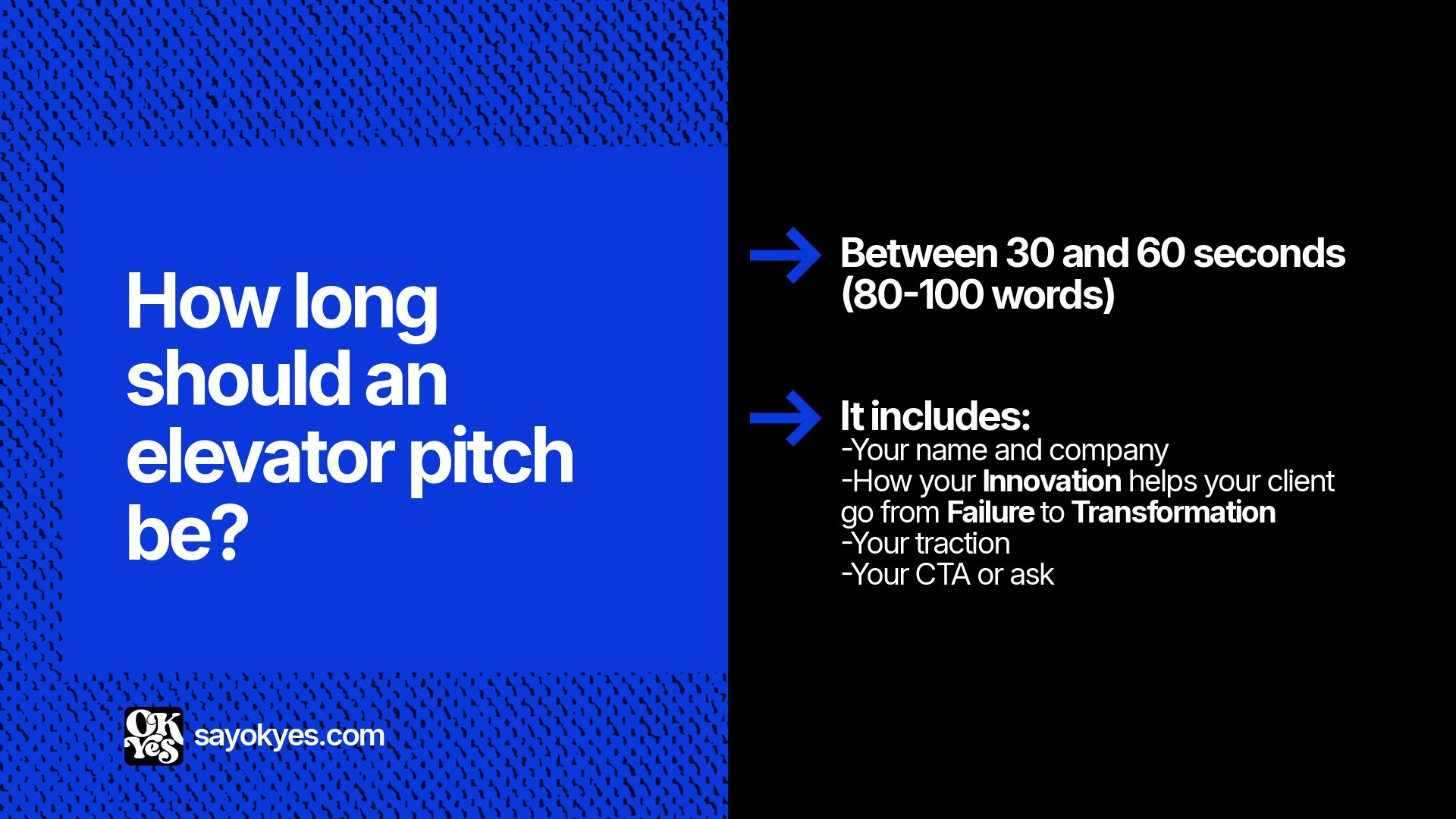
An effective elevator pitch should last around 45 seconds, or 80-100 words. This time frame is ideal to capture the attention of a potential investor, client, or partner, communicate a core idea, and spark interest in a deeper conversation. Brevity is essential to maintain attention and avoid rambling.

Why Is Duration So Important in an Elevator Pitch?

The length of an elevator pitch reflects your ability to communicate clearly and persuasively. A pitch that’s too long risks losing the listener; one that’s too short may lack substance. The optimal duration allows you to clearly present the problem, the solution, and the value—without overwhelming your audience.

This is where structure matters more than speed.

The Essential Components of a 45 Second Elevator Pitch

(Using the FIT Storyboard Method)

A strong elevator pitch follows a clear narrative arc. The FIT Storyboard helps you do this efficiently:

1. Your information

Your name and last name, your role and the name of your company.

2. A quick description

Before a longer explanation, provide a very short summary of who's your target client and the biggest benefit you offer delivers to them.

3. Failure (The Problem)

Clearly identify the problem your client faces. This is the tension point—the pain, inefficiency, or missed opportunity that currently exists.

4. Innovation (The Solution)

Explain how your product, service, or idea addresses that problem better than anyone else. Keep it simple and outcome-focused, not technical.

5. Transformation (The Outcome)

Describe the result after your solution is implemented. What changes? What improves? What becomes possible?

6. Traction

This is your value differentiation. Any proof you’re onto something (users, sales, partnerships or recurring revenue)

7. The Ask or CTA (Call-to-action)

End with a clear next step: a follow-up conversation, a meeting, a demo, or an introduction.

Here's an example of an elevator pitch following the FIT Method

I’m John Smith, CEO of CRYSPR, a fresh-produce subscription service for busy families who want to feed their kids healthier meals. It’s hard for parents juggling work and family life to keep their fridge stocked with nutritious options. CRYSPR solves this with weekly doorstep deliveries of organic fresh fruits and vegetables, helping young families support their kids’ growth without the hassle of supermarket runs. To date, we’ve reached 1,000 active subscriptions, and we’re raising $250,000 to invest in a new refrigeration system to support our next phase of growth.

How to Prepare an Effective Elevator Pitch Within the Time Limit

Preparation is non-negotiable. Here’s how to do it right:

  • Define the Objective
    Know exactly what you want from the pitch (a meeting, interest, funding, a referral).

  • Structure the Message
    Use the FIT Storyboard to guide your narrative: Failure → Innovation → Transformation.

  • Practice Ruthlessly
    Practice until you can deliver it naturally within 30–60 seconds without rushing.

  • Get Feedback
    Test it on people who will tell you the truth, not just what sounds nice.

  • Adapt to the Audience
    The story stays the same; the emphasis changes based on who’s listening.

Common Elevator Pitch Mistakes to Avoid

  • Being Too Technical
    If they don’t understand it instantly, you’ve lost them.

  • No Clear Objective
    A pitch without direction feels pointless.

  • Lack of Practice
    Unprepared pitches ramble. Rambling kills credibility.

  • Generic Messaging
    One-size-fits-all pitches resonate with no one.

  • Ignoring Listener Signals
    A pitch is a conversation starter, not a monologue.

How to Measure the Success of an Elevator Pitch

I absolutely love going networking, and I'm very excited to hear how people explain their businesses when I first meet them. But it's one thing to create a memorize an elevator pitch, a whole other to use it in a real world context.
In my experience, I never introduce myself with the elevator pitch (I always use my short handshake intro formula.) I only offer my elevator pitch once the conversation has reached a point where there's familiarity, and it comes in as a natural response.

You’ll know your pitch works if:

  • The listener asks follow-up questions

  • The core message is clearly understood

  • The value is immediately perceived

  • A personal connection is established

  • There’s a concrete next step (meeting, intro, opportunity)

If none of that happens, the pitch didn’t fail; you just got feedback.

Additional Resources to Improve Your Elevator Pitch

  • Books & Articles on storytelling and persuasive communication

  • Courses & Workshops on pitching and public speaking

  • Mentors or Pitch Coaches for direct, personalized feedback

  • Networking Events to test your pitch in real-world conditions

  • Online Platforms to record, review, and refine your delivery

Steps to Create an Impactful Elevator Pitch (FIT-Based)

  1. Define your audience and tailor the message.

  2. Identify the core Failure (problem).

  3. Present your Innovation (solution).

  4. Highlight the Transformation (outcome).

  5. Clarify what makes you different.

  6. End with a specific call to action.

  7. Practice until it sounds effortless.

Start Today

Start refining your elevator pitch today. Clarify your objective, structure your message using the FIT Storyboard, and practice until it feels natural and confident. A well-crafted elevator pitch doesn’t just sound good—it opens doors.

An effective elevator pitch should last around 45 seconds, or 80-100 words. This time frame is ideal to capture the attention of a potential investor, client, or partner, communicate a core idea, and spark interest in a deeper conversation. Brevity is essential to maintain attention and avoid rambling.

Why Is Duration So Important in an Elevator Pitch?

The length of an elevator pitch reflects your ability to communicate clearly and persuasively. A pitch that’s too long risks losing the listener; one that’s too short may lack substance. The optimal duration allows you to clearly present the problem, the solution, and the value—without overwhelming your audience.

This is where structure matters more than speed.

The Essential Components of a 45 Second Elevator Pitch

(Using the FIT Storyboard Method)

A strong elevator pitch follows a clear narrative arc. The FIT Storyboard helps you do this efficiently:

1. Your information

Your name and last name, your role and the name of your company.

2. A quick description

Before a longer explanation, provide a very short summary of who's your target client and the biggest benefit you offer delivers to them.

3. Failure (The Problem)

Clearly identify the problem your client faces. This is the tension point—the pain, inefficiency, or missed opportunity that currently exists.

4. Innovation (The Solution)

Explain how your product, service, or idea addresses that problem better than anyone else. Keep it simple and outcome-focused, not technical.

5. Transformation (The Outcome)

Describe the result after your solution is implemented. What changes? What improves? What becomes possible?

6. Traction

This is your value differentiation. Any proof you’re onto something (users, sales, partnerships or recurring revenue)

7. The Ask or CTA (Call-to-action)

End with a clear next step: a follow-up conversation, a meeting, a demo, or an introduction.

Here's an example of an elevator pitch following the FIT Method

I’m John Smith, CEO of CRYSPR, a fresh-produce subscription service for busy families who want to feed their kids healthier meals. It’s hard for parents juggling work and family life to keep their fridge stocked with nutritious options. CRYSPR solves this with weekly doorstep deliveries of organic fresh fruits and vegetables, helping young families support their kids’ growth without the hassle of supermarket runs. To date, we’ve reached 1,000 active subscriptions, and we’re raising $250,000 to invest in a new refrigeration system to support our next phase of growth.

How to Prepare an Effective Elevator Pitch Within the Time Limit

Preparation is non-negotiable. Here’s how to do it right:

  • Define the Objective
    Know exactly what you want from the pitch (a meeting, interest, funding, a referral).

  • Structure the Message
    Use the FIT Storyboard to guide your narrative: Failure → Innovation → Transformation.

  • Practice Ruthlessly
    Practice until you can deliver it naturally within 30–60 seconds without rushing.

  • Get Feedback
    Test it on people who will tell you the truth, not just what sounds nice.

  • Adapt to the Audience
    The story stays the same; the emphasis changes based on who’s listening.

Common Elevator Pitch Mistakes to Avoid

  • Being Too Technical
    If they don’t understand it instantly, you’ve lost them.

  • No Clear Objective
    A pitch without direction feels pointless.

  • Lack of Practice
    Unprepared pitches ramble. Rambling kills credibility.

  • Generic Messaging
    One-size-fits-all pitches resonate with no one.

  • Ignoring Listener Signals
    A pitch is a conversation starter, not a monologue.

How to Measure the Success of an Elevator Pitch

I absolutely love going networking, and I'm very excited to hear how people explain their businesses when I first meet them. But it's one thing to create a memorize an elevator pitch, a whole other to use it in a real world context.
In my experience, I never introduce myself with the elevator pitch (I always use my short handshake intro formula.) I only offer my elevator pitch once the conversation has reached a point where there's familiarity, and it comes in as a natural response.

You’ll know your pitch works if:

  • The listener asks follow-up questions

  • The core message is clearly understood

  • The value is immediately perceived

  • A personal connection is established

  • There’s a concrete next step (meeting, intro, opportunity)

If none of that happens, the pitch didn’t fail; you just got feedback.

Additional Resources to Improve Your Elevator Pitch

  • Books & Articles on storytelling and persuasive communication

  • Courses & Workshops on pitching and public speaking

  • Mentors or Pitch Coaches for direct, personalized feedback

  • Networking Events to test your pitch in real-world conditions

  • Online Platforms to record, review, and refine your delivery

Steps to Create an Impactful Elevator Pitch (FIT-Based)

  1. Define your audience and tailor the message.

  2. Identify the core Failure (problem).

  3. Present your Innovation (solution).

  4. Highlight the Transformation (outcome).

  5. Clarify what makes you different.

  6. End with a specific call to action.

  7. Practice until it sounds effortless.

Start Today

Start refining your elevator pitch today. Clarify your objective, structure your message using the FIT Storyboard, and practice until it feels natural and confident. A well-crafted elevator pitch doesn’t just sound good—it opens doors.

An effective elevator pitch should last around 45 seconds, or 80-100 words. This time frame is ideal to capture the attention of a potential investor, client, or partner, communicate a core idea, and spark interest in a deeper conversation. Brevity is essential to maintain attention and avoid rambling.

Why Is Duration So Important in an Elevator Pitch?

The length of an elevator pitch reflects your ability to communicate clearly and persuasively. A pitch that’s too long risks losing the listener; one that’s too short may lack substance. The optimal duration allows you to clearly present the problem, the solution, and the value—without overwhelming your audience.

This is where structure matters more than speed.

The Essential Components of a 45 Second Elevator Pitch

(Using the FIT Storyboard Method)

A strong elevator pitch follows a clear narrative arc. The FIT Storyboard helps you do this efficiently:

1. Your information

Your name and last name, your role and the name of your company.

2. A quick description

Before a longer explanation, provide a very short summary of who's your target client and the biggest benefit you offer delivers to them.

3. Failure (The Problem)

Clearly identify the problem your client faces. This is the tension point—the pain, inefficiency, or missed opportunity that currently exists.

4. Innovation (The Solution)

Explain how your product, service, or idea addresses that problem better than anyone else. Keep it simple and outcome-focused, not technical.

5. Transformation (The Outcome)

Describe the result after your solution is implemented. What changes? What improves? What becomes possible?

6. Traction

This is your value differentiation. Any proof you’re onto something (users, sales, partnerships or recurring revenue)

7. The Ask or CTA (Call-to-action)

End with a clear next step: a follow-up conversation, a meeting, a demo, or an introduction.

Here's an example of an elevator pitch following the FIT Method

I’m John Smith, CEO of CRYSPR, a fresh-produce subscription service for busy families who want to feed their kids healthier meals. It’s hard for parents juggling work and family life to keep their fridge stocked with nutritious options. CRYSPR solves this with weekly doorstep deliveries of organic fresh fruits and vegetables, helping young families support their kids’ growth without the hassle of supermarket runs. To date, we’ve reached 1,000 active subscriptions, and we’re raising $250,000 to invest in a new refrigeration system to support our next phase of growth.

How to Prepare an Effective Elevator Pitch Within the Time Limit

Preparation is non-negotiable. Here’s how to do it right:

  • Define the Objective
    Know exactly what you want from the pitch (a meeting, interest, funding, a referral).

  • Structure the Message
    Use the FIT Storyboard to guide your narrative: Failure → Innovation → Transformation.

  • Practice Ruthlessly
    Practice until you can deliver it naturally within 30–60 seconds without rushing.

  • Get Feedback
    Test it on people who will tell you the truth, not just what sounds nice.

  • Adapt to the Audience
    The story stays the same; the emphasis changes based on who’s listening.

Common Elevator Pitch Mistakes to Avoid

  • Being Too Technical
    If they don’t understand it instantly, you’ve lost them.

  • No Clear Objective
    A pitch without direction feels pointless.

  • Lack of Practice
    Unprepared pitches ramble. Rambling kills credibility.

  • Generic Messaging
    One-size-fits-all pitches resonate with no one.

  • Ignoring Listener Signals
    A pitch is a conversation starter, not a monologue.

How to Measure the Success of an Elevator Pitch

I absolutely love going networking, and I'm very excited to hear how people explain their businesses when I first meet them. But it's one thing to create a memorize an elevator pitch, a whole other to use it in a real world context.
In my experience, I never introduce myself with the elevator pitch (I always use my short handshake intro formula.) I only offer my elevator pitch once the conversation has reached a point where there's familiarity, and it comes in as a natural response.

You’ll know your pitch works if:

  • The listener asks follow-up questions

  • The core message is clearly understood

  • The value is immediately perceived

  • A personal connection is established

  • There’s a concrete next step (meeting, intro, opportunity)

If none of that happens, the pitch didn’t fail; you just got feedback.

Additional Resources to Improve Your Elevator Pitch

  • Books & Articles on storytelling and persuasive communication

  • Courses & Workshops on pitching and public speaking

  • Mentors or Pitch Coaches for direct, personalized feedback

  • Networking Events to test your pitch in real-world conditions

  • Online Platforms to record, review, and refine your delivery

Steps to Create an Impactful Elevator Pitch (FIT-Based)

  1. Define your audience and tailor the message.

  2. Identify the core Failure (problem).

  3. Present your Innovation (solution).

  4. Highlight the Transformation (outcome).

  5. Clarify what makes you different.

  6. End with a specific call to action.

  7. Practice until it sounds effortless.

Start Today

Start refining your elevator pitch today. Clarify your objective, structure your message using the FIT Storyboard, and practice until it feels natural and confident. A well-crafted elevator pitch doesn’t just sound good—it opens doors.

Alejandra Copeland, Founder of Ok Yes Pitch Storytelling

About Ok Yes Founder, Alejandra Copeland

Alejandra Copeland cut her teeth as a visual communication expert by producing and editing video content for MTV Networks, NBC Universal, and Viacom. Since 2004, Alejandra has pushed Andromeda Productions as a premier marketing video production agency. She has created enduring client relationships with multiple Fortune 500 companies such as MasterCard and Sony Music US Latin.

Alejandra Copeland cut her teeth as a visual communication expert by producing and editing video content for MTV Networks, NBC Universal, and Viacom. Since 2004, Alejandra has pushed Andromeda Productions as a premier marketing video production agency. She has created enduring client relationships with multiple Fortune 500 companies such as MasterCard and Sony Music US Latin.

All rights reserved © 2026 OK YES LLC.

All rights reserved © 2026 OK YES LLC.

All rights reserved © 2026 OK YES LLC.