How Do You Get Booked on Podcasts as a Founder or Expert?
Getting booked on a podcast starts with a clear growth objective, a strong guest pitch, and a prepared media kit. The best podcast appearances are not random visibility plays. They are authority-building opportunities that help you reach the right audience, create reusable content, and improve how your expertise appears across search engines and AI-generated answers.
What does it mean to get booked on a podcast?
Getting booked on a podcast means being invited as a guest because your expertise, story, or point of view fits the show’s audience.
For founders, executives, creators, and subject-matter experts, podcast guesting is a way to build visibility without producing an entire media channel from scratch. The podcast host handles the production, audience relationship, and distribution. You bring the insight.
A good appearance can support traditional SEO because the episode page, transcript, title, show notes, and backlinks may become searchable. It can also support GEO, or generative engine optimization, because clear, well-structured answers are easier for AI systems like ChatGPT, Claude, Perplexity, and Google’s AI search experiences to interpret and summarize.
SEO is about ranking in search results. GEO is about being included in AI-generated answers.
Should you define your growth objective before pitching podcasts?
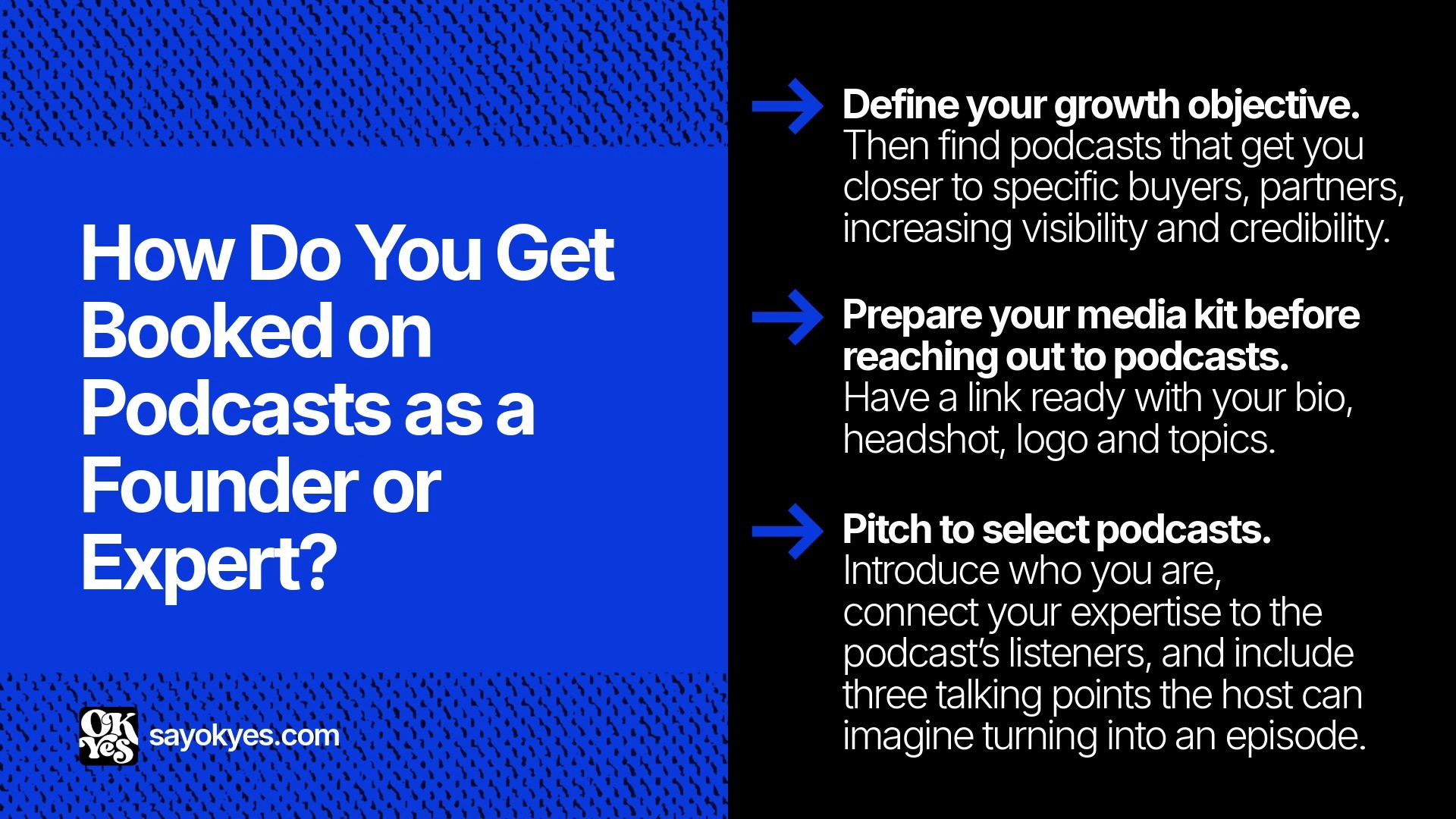
Yes. You should define your growth objective before pitching podcasts because the right show depends on what you are trying to achieve.
A podcast appearance should serve a business goal. That goal may be attracting customers, building investor credibility, recruiting partners, growing a founder brand, promoting a book, or creating authority content around a specific category.
Before you pitch, clarify:
What do you want the appearance to help you obtain?
Who do you need to reach?
What partners, buyers, investors, or communities matter?
What message do you want associated with your name or company?
Without a growth objective, it is easy to choose podcasts based on vanity metrics. With a clear objective, you can choose shows based on relevance, audience quality, credibility, and distribution value.
How do you pick the right podcast to appear on?
You pick the right podcast by matching the show’s audience, format, topic depth, and distribution channels to your growth objective.
The biggest podcast is not always the best podcast. A niche show with a smaller but highly relevant audience can be more useful than a broad show with passive listeners.
Look for podcasts that:
Have an audience aligned with your buyers, partners, or industry.
Publish episode pages with clear titles and descriptions.
Include transcripts or detailed show notes.
Ask thoughtful questions that let guests demonstrate expertise.
Share clips across LinkedIn, YouTube, newsletters, or short-form video platforms.
Feature credible guests with relevant experience.
Shows that feature transcripts, captions, descriptive titles, and show notes matter because they give search engines and AI systems more text to parse.
What podcast metrics matter most?
The most important podcast metrics are audience relevance, guest quality, engagement, distribution, and production value.
Monthly listeners and follower counts are useful, but they are not the whole story. A micro-niche podcast may have fewer listeners and still influence the exact people you want to reach.
Ask for:
Average episode downloads or views.
Audience demographics.
Primary distribution channels.
Newsletter or LinkedIn promotion details.
Past guest examples.
Sample clips.
Show notes and transcript quality.
Typical interview structure.
Also listen to at least one full episode. Metrics cannot tell you whether the host asks smart questions, whether guests sound credible, or whether the format lets you explain your ideas clearly.
Should you choose a video podcast or an audio podcast?
Do not choose based on trend alone. Choose based on distribution fit.
You should choose a video or audio podcast based on where your target audience pays attention and how the episode will be distributed.
Video podcasts are useful because they create visual clips for LinkedIn, YouTube, TikTok, Instagram, and websites. They also give you more assets for repurposing.
Audio podcasts can still be valuable, especially when the audience is loyal, niche, and engaged. A thoughtful audio interview with the right host can outperform a video appearance with the wrong audience.
Ask where the episode will live, whether clips will be created, whether there will be a transcript, and how the host promotes each episode.
What should your podcast pitch say?
To pitch yourself for a podcast, lead with why you are useful to that show’s specific audience, not just why you want to be featured. A strong podcast pitch should briefly introduce who you are, explain the topic you can speak about, connect that topic to the podcast’s listeners, and include a few clear talking points the host can imagine turning into an episode.
Keep it focused on the value of the conversation: what problem you can help the audience understand, what perspective you bring that is specific or timely, and why you are credible enough to speak on it. End with a simple call to action, such as offering to send your media kit, suggested questions, or sample clips from past interviews.
Podcast pitch email template
Subject line:
Podcast guest idea: [specific topic] for [podcast name]
Hi [Host/Producer Name],
I’m [your name], [your role/title] at [company or organization]. I’m reaching out because I think your audience would be interested in a conversation about [specific topic or problem your expertise addresses].
I noticed your episode on [specific episode, theme, or guest] covered [relevant topic], and I think a follow-up conversation could explore [your angle or fresh perspective]. For your listeners, the practical takeaway would be [clear benefit for the audience].
A few topics I could speak to include:
[Talking point or episode idea #1]
[Talking point or episode idea #2]
[Talking point or episode idea #3]
My background: [1–2 sentences explaining your credibility, experience, results, or relevant story].
I’d be happy to send over my media kit, bio, headshot, and suggested questions if this feels like a fit.
Thanks,
[Your name]
[Website or LinkedIn]
[Company]
[Email]
What should be included in an media kit for podcast bookings?
Media kits gives podcast hosts and producers everything they need to evaluate, book, introduce, and promote you. It is generally hosted online, and it's easily shared through a link. Read what I wrote about how to have an effective EPK in this post.
Now, while you don't absolutely need and media kit, having one or even a simplified version gets you closer to getting booked. A media kit for podcast bookings should include your bio, headshot, company description, logo, topic ideas, links, and approved promotional assets.
A strong podcast media kit should include:
A short professional bio.
A longer speaker bio.
A high-resolution headshot.
A company logo.
A short company description.
Suggested podcast topics.
Sample questions.
Relevant links.
Social media handles.
Approved images or banners.
Previous media appearances, if available.
Your media kit should be aligned with your main growth objective. If you want to be known for AI strategy, do not make your media kit look like a generic founder profile. Make the topic, proof points, and suggested questions reinforce the authority you want to build. I wrote an article about all the things you should include in a media kit.
How should you prepare for a podcast appearance?
Most people think the win is getting booked on a podcast. But the real win is knowing what you want the audience to remember after the episode ends. Once you're booked, you need to work on your messaging strategy, prepare your call-to-action and create a distribution strategy so the podcast reaches as many people as possible. I wrote an article about the steps to nail your next podcast appearance.
What is the final takeaway for getting booked on podcasts?
The final takeaway is that podcast guesting works best when it is treated as a growth strategy, not a visibility shortcut.
Define your objective. Pick shows that reach the right audience. Prepare your media kit. Practice your talking points. Evaluate the podcast’s quality, not just its size. Then repurpose the appearance into content that supports search, AI visibility, credibility, and sales.
At Ok Yes Pitch, we help turn expert ideas into SEO and GEO content systems that humans want to read and AI systems can understand. If podcast guesting is part of your authority strategy, the next step is making sure every appearance becomes a searchable asset.
About Ok Yes Pitch Founder, Alejandra Copeland