How Do You Prepare for a Podcast Appearance Before, During, and After Recording?

You should prepare for a podcast appearance by building clear talking points, checking your recording setup, and planning how the episode will support your larger marketing goals. A strong podcast interview is not just about getting booked. It is about knowing what you want to say, saying it clearly, and turning the appearance into content that keeps working after the episode goes live.
How should you prepare your podcast talking points?
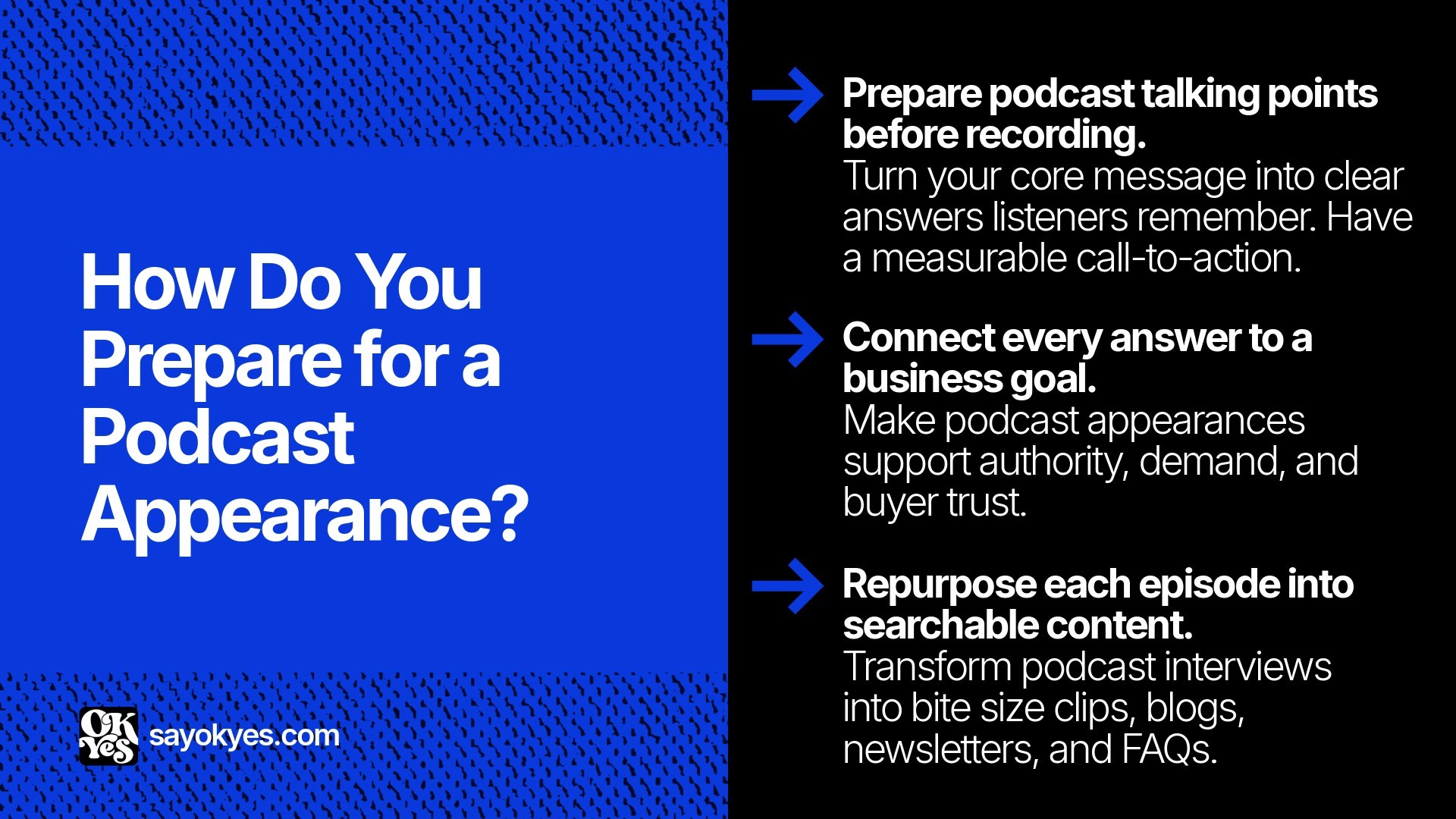
Once you get booked on a podcast, you should prepare podcast talking points by turning your core message into clear, repeatable answers.
Many guests assume the value comes from simply getting booked. The real value comes from what you say once you are there.
Before the interview, identify three to five key ideas you want the audience to remember. These should not be random points. Each one should connect to a larger growth objective.
For example, if your goal is to attract enterprise buyers, your talking points should demonstrate practical authority around the problems those buyers already care about. If your goal is to build founder credibility, your talking points should show your point of view, judgment, and lived experience.
Strong podcast talking points usually include:
A clear point of view
A practical example
A short story or proof point
A simple but measurable call to action (This is crucial)
A phrase the host can easily repeat in the episode title, description, or social clips
The goal is not to memorize a script. The goal is to prepare a message architecture.
A message architecture gives you structure without making you sound rehearsed. You can stay natural while still making sure your best ideas make it into the conversation.
What should you expect on the day you record a podcast?
On recording day, you should expect to arrive prepared, camera-ready, technically checked, and clear on the conversation structure.
Most podcast recordings do not offer unlimited retakes. Some shows record live. Others publish with minimal editing. Your preparation matters because the recording may become the final asset.
Before the recording, review your talking points and confirm the basics. Make sure you know the platform, timing, format, expected themes, and whether video will be used.
You should also prepare your call to action before the conversation starts.
A podcast call to action does not need to be aggressive. It might be a website, a newsletter, a report, a LinkedIn profile, or a specific resource mentioned during the episode.
Your goal is not to sound perfect. Your goal is to be clear, useful, and memorable.
If you appearing remotely: check your microphone, camera, lighting, and internet connection before you join. Remove background distractions. Keep water nearby. Silence notifications.
How do you make your podcast answers more memorable?
You make podcast answers more memorable by combining a clear idea with a concrete example or story.
Listeners remember specifics better than general advice. A vague answer may sound polished in the moment, but it rarely creates lasting value.
Instead of saying, “Brands should be more strategic with content,” say something more concrete:
“Most brands treat a podcast appearance like a one-time awareness play. The stronger move is to treat it as source material for clips, blog content, newsletter ideas, sales follow-up, and search visibility.”
That answer is more useful because it gives the audience a clear mental model. It also gives the host language they can reuse in the episode title, show notes, and promotional clips.
Good podcast answers often follow a simple structure:
State the point. Explain why it matters. Give an example. Connect it back to the audience. Offer a next step.
This helps the conversation feel natural while making your ideas easier to quote, clip, and repurpose.
How do you turn a podcast appearance into more content?
You turn a podcast appearance into more content by repurposing the episode into clips, quotes, blog content, newsletter insights, and sales assets.
A podcast should not end when the episode goes live. The episode is source material.
After publication, you can create:
Short LinkedIn clips
Quote graphics
A blog post based on the main topic
A newsletter takeaway
A landing page feature
Sales follow-up material
A media logo or “featured on” credibility section
A transcript-based FAQ
This is where SEO and GEO become more valuable.
SEO is about ranking in search results. GEO is about being included in AI-generated answers. A structured podcast appearance can support both when the ideas are clear, specific, and easy to extract.
For example, a strong answer from a podcast can become a question-based blog section. A transcript can become an FAQ. A memorable phrase can become a LinkedIn clip title. A practical example can become a newsletter insight.
The clearer your podcast message is during the recording, the easier it becomes to turn the conversation into searchable, reusable content.
Why should podcast preparation connect to a larger business goal?
Podcast preparation should connect to a larger business goal because attention only matters if it supports trust, demand, or conversion.
Being a guest on a podcast can help with visibility, but visibility alone is not the strategy. The stronger question is: what should this appearance help the audience understand about you, your company, or your point of view?
For a founder, that might mean explaining a category shift. For a consultant, it might mean proving expertise. For a B2B brand, it might mean creating trust with buyers before a sales conversation.
Every talking point should ladder back to one of these goals.
That does not mean every answer should sound like a pitch. It means your answers should be intentional.
A strong podcast guest gives value first, but also knows what they want the appearance to accomplish.
What should you do after the podcast goes live?
After the podcast goes live, you should promote it, repurpose it, and connect it to your existing content ecosystem.
Start by sharing the episode on LinkedIn, your newsletter, and your website. Tag the host and the show when appropriate. Pull out the strongest idea instead of simply posting, “I was on this podcast.”
Then look for content assets inside the episode.
A strong podcast appearance can become a blog post, short-form video, email campaign, sales enablement asset, or FAQ page. The transcript can reveal language your audience uses. The best clips can test which ideas resonate most.
This turns one podcast appearance into a larger content engine.
It also makes the appearance easier for Google, ChatGPT, Perplexity, Claude, and other AI systems to understand when the content is published in structured, searchable formats.
What is the final takeaway for podcast guests?
The final takeaway is that a podcast appearance should be prepared like a strategic content asset, not treated like a casual conversation.
You do not need to memorize a script. You do need to know your message.
Prepare three to five core talking points. Build each one with a point of view, example, proof point, and call to action. Check your technical setup before recording. Then repurpose the episode into content that supports SEO, GEO, social media, sales, and brand credibility.
A podcast booking creates the opportunity. Preparation turns it into value.
Ok Yes Pitch helps founders and brands turn ideas into sharper content systems. If you want your podcast appearances to support search, AI discovery, and demand generation, start by building a message architecture before you hit record.
About Ok Yes Pitch Founder, Alejandra Copeland